
New York Cardinal Timothy Dolan, who recently retired from his role as archbishop of New York, shared his reflections on the nation’s 250th anniversary, ICE, Catholic politicians, and human dignity.
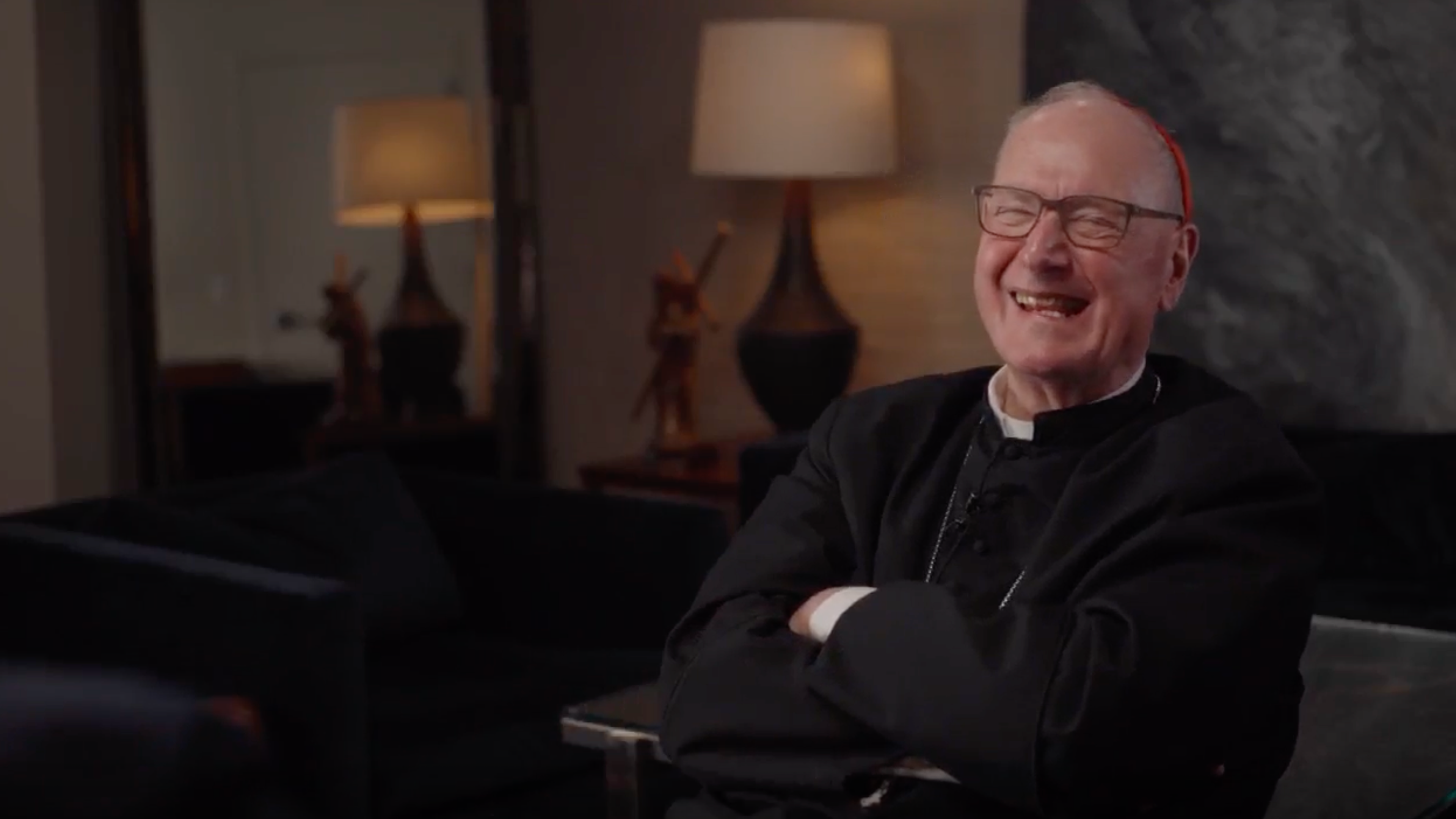
The now-retired archbishop of New York, Cardinal Timothy Dolan, said he is now a “spiritual grandad” to the people of New York.
“You never retire from being a priest or a bishop,” Dolan told reporter Mark Irons in an interview with “EWTN News In Depth” where Dolan shared his thoughts on the 250th anniversary of the U.S., ICE, Catholic politicians, and the dignity of human life.
Though he has retired from the assignment, Dolan said he is a priest and bishop “forever.”
“I tell my people, I’m not your spiritual father anymore. I’m your spiritual granddad,” Dolan said.
Dolan will go on to serve the city as co-chaplain of the New York Police Department alongside an evangelical pastor from the African American community, Rev. A.R. Bernard, pastor and founder of the Christian Cultural Center in Brooklyn.
Of his successor, Archbishop Ronald Hicks, Dolan said: “I admire him immensely,” and “he’s a real gem.”
Dolan is less enthusiastic about Zohran Mamdani, the new mayor of New York City — though he says there are issues they are aligned on.
“His openness to the immigrant, his desire for fair housing, his earnest desire to increase the income and the prosperity of most of the people in this town,” Dolan listed. “If those are issues that he’s favorable to, I’d say, bingo — let’s go with it.”
Dolan confessed he was “ticked off” that Mamdani didn’t attend Hicks’ installation and did not invite Dolan to his inauguration — something he said he feels goes against the religious “amity” in New York.
“One of the many things I love about New York is the amity among the different religions,” Dolan said. “We all get together. We all enjoy one another. The ecumenical and interfaith health of this city is phenomenal.”
The cardinal had expected Mamdani to attend given that “a big chunk of the citizens of this great city profess the one, holy, catholic, and apostolic Church as their family of religious choice,” he explained.
“The Church has an amazing part to play in the social fabric of this metropolis,” Dolan added.
In fact, Dolan shared that he and Rev. Franklin Graham, a fellow member of the U.S. Religious Liberty Commission and son of the late evangelist Rev. Billy Graham, teamed up on the issue of immigration enforcement operations to protect religious freedom and church attendance.
He and Graham, he said, “were very worried when [U.S. Immigration and Customs Enforcement, ICE] started going into churches and harassing churches” in the Archdiocese of New York.
“ICE would show up on Sunday Mass just in trucks and cars, and the people wouldn’t come,” Dolan said.
Dolan called it a “violation of religious freedom.”
“People have the right to worship,” he said. “The federal government cannot impede that or harass it, and they are.”
So he and Graham went to the director of ICE in New York, who agreed, saying “We’re not going to do that here,” according to Dolan.
But not every outreach to New York officials yields results. Though Dolan outspokenly opposed the recent physician assisted suicide bill — even speaking personally with Gov. Kathy Hochul, a practicing Catholic, about it — Hochul signed the bill earlier this month.
Dolan sees a connection between the bill and New York’s policy on abortion.
“I’m not surprised,” Dolan said of the passage. “Because why should not the abortion capital of the United States, if not the world, New York, now become the euthanasia capital?”
“If human life is cheap — if the dignity of the human person and the sacredness of the human life is not respected, especially when it’s most vulnerable: the baby in the womb or grandma in hospice — why would we not be surprised?” he continued.
“If human life is thought to be burdensome — if its only value is that it’s useful, or that it can produce, or that it’s not inconvenient to me — then we’re in trouble. We’re in trouble,” Dolan said. “Why do you think we have these shoot-em-ups? Why do you think we have violence on the street? Because human life is so cheap.”
When asked about the “scandal” of Catholic politicians supporting policies opposed to Church teaching, Dolan noted that Catholic moral teaching is aligned with natural law and human reason.
“It might deepen your chagrin when a committed Catholic takes positions that are contrary to the faith,” he said. “But Catholic positions are Catholic positions because they’re based on human reason, the integrity of the human person, God’s revelation in natural law.”
On politicians generally, Dolan said: “No political figure bats a thousand when it comes to are their values aligned with those of the Gospel, as professed for 2,000 years faithfully by the Church.”
But Dolan said he sees a ray of hope in the growth of Catholic influence in the U.S. since the nation’s founding.
When asked about the progression of Catholic culture in light of the 250th anniversary of the founding, Dolan said: “Catholics are well-educated. They’re prosperous. They have positions of leadership, responsibility, and service within our communities. They’re active in government. Those are ways that our Catholic values can influence the land that we love. And that sure wasn’t true at the beginning, right?”
Dolan said “Catholic values and American values are very similar” in everything from the Bible to prayer, faith, and religious freedom.
“We both believe in one nation under God. We both believe in the role of the family. We both believe in the principle of subsidiarity. We both believe in the power of democracy,” he said. “We both believe in the drive to protect the common good. Those are Catholic values; those are American values.”
But there is a danger, Dolan said, in becoming too similar to the culture.
“What’s the bad news? It’s the more similar we become to the culture, sometimes the more at odds we come with our Catholic beliefs,” he said.
“While we want to embrace what’s good and beaming in the American culture, we also know that we’re somewhat countercultural,” he said. “Why? Because our true citizenship is in heaven. And Jesus says, ‘My kingdom is not of this world.’”
If you value the news and views Catholic World Report provides, please consider donating to support our efforts. Your contribution will help us continue to make CWR available to all readers worldwide for free, without a subscription. Thank you for your generosity!
Click here for more information on donating to CWR. Click here to sign up for our newsletter.
Leave a Reply
You must be logged in to post a comment.