
French philosopher Fabrice Hadjadj has founded a new school in Spain, Incarnatus est, to advance Christian culture by cultivating it as a garden rather than defending it like a besieged fortress.

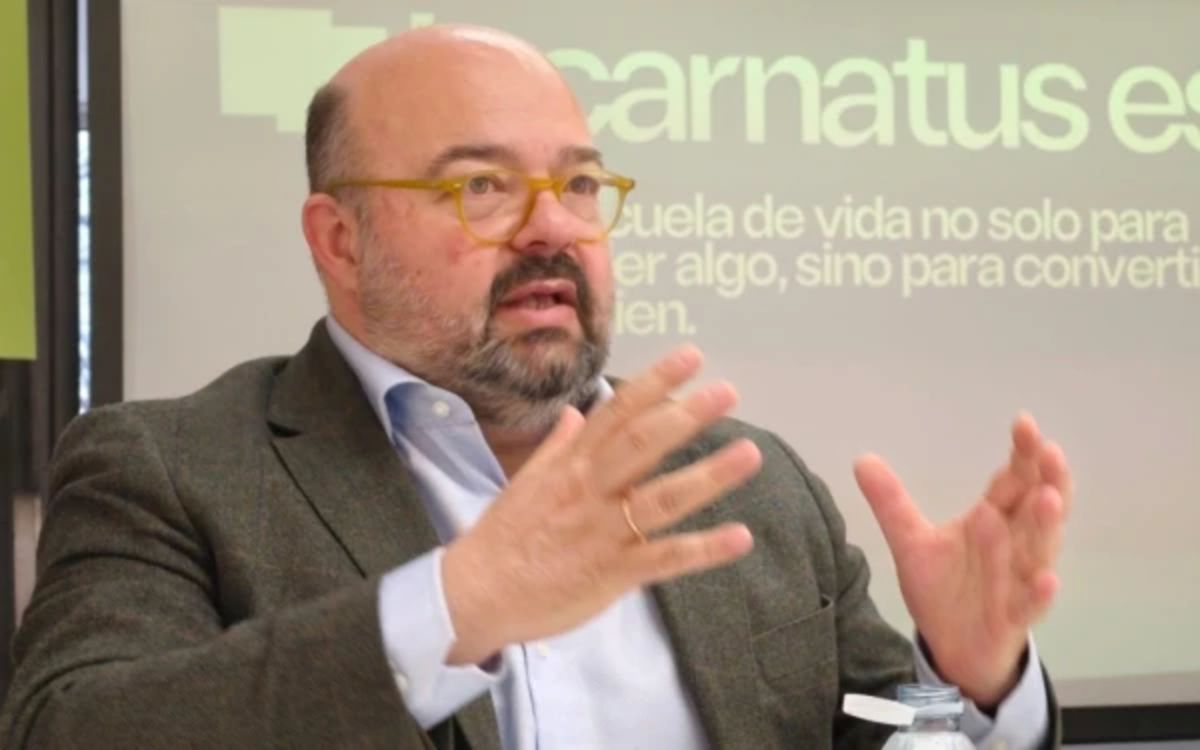
At a presentation for the newly founded Catholic institute Incarnatus est, French philosopher Fabrice Hadjadj asserted that defending Christ is “a diabolical idea” because Christ has already triumphed.
Hadjadj has moved to Spain from Switzerland, along with his wife and seven of his 10 children, to direct the comprehensive formation program that seeks to offer Christian wisdom to the enemies of the faith who, he says, are “dying of despair.”
The institute aims to train “gardeners of culture” in a monastic-style program. This new educational model, which is conceived as a kind of “medieval school,” in the words of one of its promoters, Miguel Gabián, aims to help students “learn to grapple with the ideas of our time.”
The school, directed by Hadjadj, will have a capacity of 40 students between the ages of 18 and 28 who will live as boarders throughout the course. The program seeks to integrate spiritual life with an experience of art, manual labor, and community living.
The course, which will begin in September, will be held in a former convent in the town of Boadilla del Monte, Spain, and will include spiritual exercises, regular and festive pilgrimages, cultural trips, and theater activities in its educational program.
Incarnatus est aims to establish itself as a center for the comprehensive formation of young people, a hub for the dissemination of Christian culture throughout Hispanic America, and a setting for collaboration among Catholic universities.
The cost of the course, which is open to scholarships, including 100% depending on the candidate, is 22,500 euros ($26,475) per year, covering tuition, accommodations, and off-campus activities.
During an informational meeting prior to the public presentation of Incarnatus est, which brought together nearly 500 people, Hadjadj outlined three reasons why this innovative educational proposal should not be interpreted through the lens of the “culture war.”
Hadjadj explained that this expression and the underlying premise contain three “misconceptions”: the belief that we are still in modernity, the notion that there are two cultures, and the idea of putting soldiers on the front lines.
We are no longer in modernity
For the philosopher, the polarities of modernity no longer exist: “By losing the faith, modernity has lost reason. By losing the spirit, modernity has lost the flesh,” he stated.
Thus, Christian thought today finds itself facing “a tangle, a mixture, a spiritualism or religiosity without religion, without spirit, without discernment, without reason” that characterizes postmodernity.
“It’s not true that there is an ideology of progress, a positive ideology, in opposition to the Christian mission. No. There is only despair,” he declared.
Proof of this, in his view, is the decline in birth rates in Western societies and the rise of transhumanism, which, he said, “is not a utopia; it is a smokescreen to deny the obvious fact of being an escape, of despairing.”
Miguel Gabián, promoter of the Incarnatus est program. | Credit: Nicolás de Cárdenas/ACI Prensa
Culture vs. technology
Secondly, Hadjadj maintains that it is wrong “to believe there are two cultures,” such that the Christian culture must “fight or dialogue” with the other.
However, he emphasized, “we are in times without a culture. It’s not a culture war. It’s a battle of culture against technocracy, against everything simply being a matter of data, against the reduction of everything to a calculation” in which a machine “gives you solutions, as if life were a problem to be solved and not an adventure to engage in.”
Culture, the philosopher emphasized, “takes its model from cultivation: tending to the plant, at its own pace, accompanying the development of a life, not manufacturing it.”
The third error pointed out by Hadjadj stems from considering that “culture is like a garden to cultivate, and the idea of the culture war is to place soldiers in front of a garden.” But then “where are the gardeners? So, we are defending the garden, but everything withers.”
This idea is crucial for understanding the Incarnatus est project, the philosopher emphasized, because “we have to rid ourselves of the mentality of a besieged fortress.”
“Christ is already victorious. That is our faith. The question is whether or not I will be victorious with him. But he is victorious. We don’t have to defend Christ, the Holy Spirit. That’s a diabolical idea. The Holy Spirit is the Paraclete, the Defender. If Christ’s enemies are going crazy, it’s because they have already lost, and we must, above all, have compassion for them,” Hadjadj added.
Therefore, he insisted, Incarnatus est aims to “train gardeners of culture” and not soldiers, since the stance of the “defender of Christ” strikes him as an “imposture” and a “fideism that demonstrates a lack of faith.”
The cultivation of culture, he proposed, must be done “like the monks in the times of the barbarians” to offer “the already victorious power of Christ, because the enemies of the faith are dying of despair. And, before we fight against them, we must present hope.”
Thus, Incarnatus est wants to be “a place of practical hope and a lively proposition; not with a military logic of battle,” he explained.
This story was first published by ACI Prensa, the Spanish-language sister service of EWTN News. It has been translated and adapted by EWTN News English.
If you value the news and views Catholic World Report provides, please consider donating to support our efforts. Your contribution will help us continue to make CWR available to all readers worldwide for free, without a subscription. Thank you for your generosity!
Click here for more information on donating to CWR. Click here to sign up for our newsletter.
Leave a Reply
You must be logged in to post a comment.