
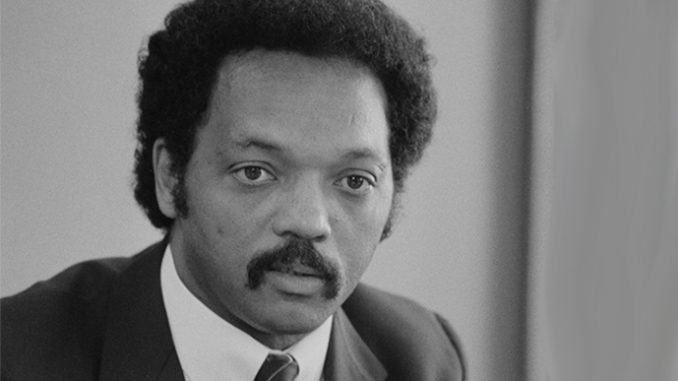
As the nation marks Jesse Jackson’s death at age 84, I realize that the temptation will be either to canonize the man as an icon of civil rights sainthood or to dismiss him as a partisan relic. But both impulses function as modern ideological shortcuts. And they deny us the harder labor of moral memory, which requires gratitude, candor, and a clear hierarchy of goods.
This is because Jesse Jackson’s passing hits the American bloodstream and forces a reckoning with a chapter of public life that communicates genuine moral urgency alongside a trail of human complication. It exposes how quickly a movement for human dignity can be taken up by people who keep the slogans while misplacing the soul and dignity of the human person.
Ambition, witness, and tragic turnabout
Jackson’s story began under the social pressure of Southern segregation and the sting of immense childhood shame. His early ambition was a combustible mixture of aspiration and protest, which is why he learned to speak with the urgency of a man who had been told, in a thousand ways, that his future should remain small or non-existent.
In that context, his rise through the civil rights movement and his proximity to Martin Luther King Jr., were marked by a genuine attempt to translate biblical anthropology into public witness. Their most potent and powerful claim involved a vision of the human person grounded in the image of God and, therefore, it was capable of summoning a nation to repent of injustice through a conscience formed by Christian truth, transcending the narrative of perpetual retaliation.
Even his own rhetoric, when it soared the hearts of the masses, often carried the cadence of biblical hope and the discipline of moral exhortation, as when he insisted, “Both tears and sweat are salty, yet they render a different result,” because, to him, tears solicit sympathy but sweat produces real change. That line still rebukes our age, which wants therapeutic recognition in place of action that costs both effort and life. Likewise, his counsel, “Never look down on anybody unless you’re helping him up,” is a simple and powerful moral test, especially for a progressivist class that survives by elites spouting aggravating narratives while looking down on activists as a renewable resource who shed blood for the elite cause.
Nevertheless, we cannot pretend that Jackson’s career can be reduced to inspirational aphorisms. Power does strange things to men who began their public life with righteous motives. And politics tends to reward ambiguity when it can be marketed as compassion. His early advocacy for the unborn, followed by later aggressive support of abortion, is nothing short of a tragic case study in how a public figure can lose the moral plot when their moral vision becomes captive to political coalition maintenance. The modern party system always enforces its own liturgy, complete with its own rituals of belonging and punishments for even a hint of doctrinal deviation.
Consequently, if the civil rights movement appealed to the natural law and divine law written on the human heart, the later political apparatus often appealed to the law written by the media, donors, polling, crony funding, and the ever-shifting requirements of elite approval.
Even so, Jackson’s repeated engagement with Pope John Paul II during his lifetime reveals something important about how he understood the stage of world affairs. He seemed to have treated the papacy as a moral platform that was above administrative institutions. He saw how it could pressure regimes and awaken human conscience beyond the reach of a political campaign speech. When he called John Paul II a dominant moral authority, he was publicly recognizing an older truth that modernity keeps trying to bury: spiritual authority, when it remains anchored in God, can outlast presidents and tyrants, and comfort the afflicted in ways that bureaucratic governments will always fail to imitate.
In that sense, Jackson’s instinct to bring humanitarian crises before the Church’s global witness is honest, since it admits that politics alone cannot heal the human wound, and that a moral voice beyond the state remains necessary for any civilization that wants to remain humane.
From civil rights to perpetual grievances
At the same time, Jackson’s death has transpired during an era when the civil rights inheritance is being repackaged into something dishonest. An ugly ideological current has seized the global black public discourse with a secular dogma that treats all grievance as identity politics, declaring equity as real justice, treating merit as a disguised sin, and preaching the West as irredeemably corrupt.
I know this because I was raised in those waters. If Jackson and King fought actual segregation, a new class of cultural commissars fights an imagined universe where every single form of social disparity becomes proof of oppression, every achievement becomes suspect, and every institution becomes guilty until it submits to ideological equity reeducation. In that climate, the word “justice” gets stretched until it means whatever the loudest coalition requires. Then it gets used like a blunt instrument against families, churches, schools, institutions, and neighborhoods that still want to speak of virtue, duty, excellence, meritocracy, and repentance. I’ve seen firsthand the ugly damage this inflicts upon families, cultures, and nations.
This is precisely where King’s legacy, and even Jackson’s earlier instincts, can function as an uncomfortable mirror. King’s moral imagination depended upon natural law and biblical claims about human dignity. It required personal responsibility as much as social reform, and it demanded that people become more virtuous rather than merely become louder. King warned against the corrosive effects of hatred and called his people to disciplined fortitude. Although he himself had flaws that historians rightly record, his public theology assumed that man can be morally formed, that the human conscience can be awakened, and that the human person is more than a node in a political power struggle.
Consequently, the modern rhetoric that trains young black men across the world to see themselves as permanent victims of the system, while simultaneously excusing moral and social vice as a sociological inevitability, is simply a betrayal of the very freedom that these earlier leaders bled to secure. It is the new captivity of the mind as a substitute for Christ’s grace-driven liberation of the soul.
The civil rights era was a profound American paradox. A nation founded on equal dignity had tolerated practices that contradicted its own moral grammar. The movement’s triumph required appealing to the nation’s biblical conscience rather than dissolving the nation’s identity. The long arc of black advancement has always depended economically upon stable families, honest work, functional schools, safe streets, and the cultivation of collective virtue that can sustain delayed gratification. But the modern ideological narratives often sabotage those very conditions by celebrating chaos as authenticity and dependency on the government as compassion.
This kind of perpetual grievance identity invites a spiral of despair. It trains the mind to interpret life through injury, and then it acts surprised when hope disappears, marriages fracture, and young men drift into nihilism, all while disguising it as cool cultural detachment to banging hip-hop backing tracks. The current obsession with race categories inevitably turns communities into a marketplace of accusations. This is why friendships become fragile, humor becomes dangerous, and social forgiveness is intolerable, since forgiveness requires a shared moral and religious horizon rather than a permanent ledger of collective guilt.
The way forward
When a young person is taught to introduce himself as a racial category before he introduces himself as a child of the covenant, or a son, a brother, a student, a worker, a neighbor, a disciple, or a citizen, he is being trained to live as a fragment in a neo-Marxist framework, rather than as a whole person. Moreover, when institutions teach that a man’s moral agency is secondary to his demographic label, they rob him of the very dignity they claim to defend, because dignity includes responsibility, and responsibility includes the power to choose wisely even under pressure.
In that light, the modern fixation on equity is nothing but counterfeit compassion; it offers outcomes without formation and entitlement without excellence, and then it wonders why minority societies grow brittle and collapse.
Again, I write this personally as a man whose own family line carries the bruises of slavery within a few generations. And yet my life has also carried the grace of God’s providence in ways that have saved me from the heinous victimhood narrative I grew up in. Consequently, I refuse to be defined by ancestral crimes. I refuse to be defined by parental failure. And I refuse to be defined by my own sins, since I am defined by the love of God poured out in Jesus Christ. Therefore, my choices must flow from that core reality rather than from an identity politics of resentment that channels outrage to every person with paler skin than I.
When Jackson said, “Hold your head high, stick your chest out,” and then added, “It gets dark sometimes, yet morning comes,” he was pointing all of us toward a human resilience that depends upon hope, and hope depends upon a horizon much larger than the state, larger than a party, larger than a grievance, and larger than the self. That hope is grounded in Christ Jesus alone.
Accordingly, the proper fruition of the civil rights struggle requires a refusal to think in racial categories as ultimate categories. The human person is first and foremost a creature made by God and ordered toward God, and only then as a bearer of any secondary trait that history has weaponized. Don’t get me wrong—this does not erase history, and it does not deny injustice, and it does not excuse cruelty. I will be the first to admit that moral truth requires honest memory. However, it does insist that redemption is possible, and redemption begins when man receives his identity as a gift of God, rather than seizing the identity as a blind political cudgel.
In that sense, the future of global black flourishing, the future of American sanity, and the future of Western revival will depend less upon ideological training sessions and more upon the renewal of families, parishes, neighborhoods, schools, work ethics, and open social meritocracy. That will be where virtue is praised, where truth can be spoken, where hard work yields productive social fruit, where the common good is the shared goal of all, where forgiveness can be offered, and where excellence can be demanded in love.
The Church’s position, when she speaks from her perennial wisdom, is both sharper and more hopeful than the slogans of the age.
She insists that every human person possesses inviolable dignity from conception to natural death. She insists that injustice is real and must be confronted, and that sin is also real and must be confessed. She also insists that salvation comes through the covenant mercy of God rather than through political theater. If the world wants a program, the Church offers a Person: Jesus Christ gathers Jews and Gentiles into one covenant family, baptizes men into a new identity, heals the wounds of hatred through the Cross, and commands a love that overcomes the tribal and identity politics calculus.
Consequently, the final word over Jesse Jackson’s life, over America’s racial history, and over the modern ideological captivity of the mind belongs to the covenant Lord who makes all things new. In Christ, we are children of the Father, members of His household, and heirs of a Kingdom where dignity is secured by Christ’s grace, and where eternal hope remains alive because the risen Jesus still reigns.
If you value the news and views Catholic World Report provides, please consider donating to support our efforts. Your contribution will help us continue to make CWR available to all readers worldwide for free, without a subscription. Thank you for your generosity!
Click here for more information on donating to CWR. Click here to sign up for our newsletter.
Leave a Reply
You must be logged in to post a comment.