
With the overturning of Roe v. Wade and Planned Parenthood v. Casey in 2022, many pro-lifers thought that abortion rates were certain to plummet from that point forward. Unfortunately, that has not been the case. While surgical abortions have certainly decreased in frequency, chemical abortions (through the use of the so-called “morning after pill”) have drastically increased.
Chemical abortions are typically performed in very early stages of pregnancy, which makes it easier and easier for those involved in procuring and performing the abortion to deny the reality of what is happening, to deny the existence of the unique and unrepeatable human who is being killed in the process.
However, there are cases where a chemical abortion is initiated, and then the woman changes her mind and wants to halt and reverse the process. Through a deep understanding of how the human body—and specifically the female reproductive system and hormones—works, Dr. George Delgado and others developed a process to do just that.
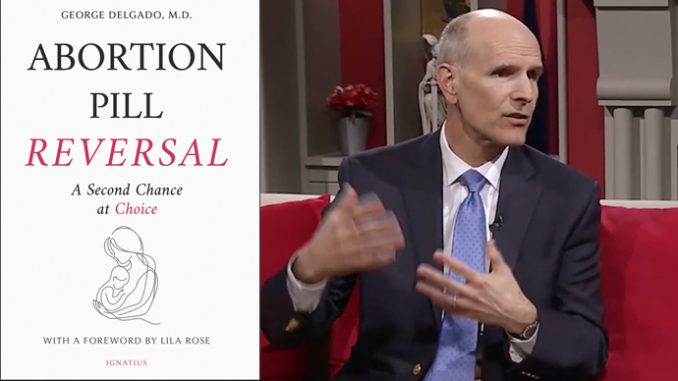
Delgado’s story is the subject of Abortion Pill Reversal: A Second Chance at Choice, his new book published by Ignatius Press. The book chronicles Delgado’s development of the Abortion Pill Reversal (APR) process, the challenges along the way, and includes personal accounts by women who attempted APR to reverse the chemical abortions that they had initiated, and others whose lives have been affected by this process.
Dr. Delgado recently spoke with Catholic World Report about his new book, his development of Abortion Pill Reversal, and the importance of fighting against all forms of abortion
Catholic World Report: How did the book come about?
Dr. George Delgado: I wanted to present, in a manner understandable to the general public, the history of abortion pill reversal (APR). This includes how mifepristone causes abortion and how progesterone can reverse its effects.
CWR: Tell us a little about the Medical-Abortion Complex you describe in the book, which tries to suppress information and knowledge about Abortion Pill Reversal (APR)?
Delgado: The medical-abortion complex is a functional alliance of different organizations and individuals who are strong supporters and proponents of abortion.
It includes Planned Parenthood, American College of Obstetricians and Gynecologists, American Civil Liberties Union and more.
CWR: The story of how you came to develop the method for abortion pill reversal seems incredibly providential–your expertise on progesterone and the way it works in the body, and the desire of those two patients to arrest and reverse the chemical abortions they had started. You were in the right place at the right time, and the rest is history. Do you see God’s hand in that?
Delgado: I most certainly see God’s hand in all of it. Prior to its approval in the U.S. in the year 2000, I had a keen curiosity in mifepristone (originally known as RU-486) and learned a great deal about it.
Around 2003, I completed the one-year certification program in NaProTECHNOLOGY that taught me how to use progesterone in women with low levels in pregnancy.
Both of those knowledge bases—how life pristine works and how to use progesterone—were critical for me to devise my first progesterone protocol for APR.
CWR: Even among a certain set of conservatives and pro-lifers, the chemical abortion pill seems to have less of a stigma. It’s almost as if some don’t see it as a real abortion, or not as horrific as dismemberment, or something. How would you respond? (For this question, you might also take into account the fact that while abortion access has been limited in recent years, and “clinics” have been closing across the country, the abortion pill is even more common than ever before.)
Delgado: Just as it makes little difference if you poison someone with cyanide versus stabbing him to death, there is little difference in the outcome of chemical versus surgical abortion. One difference that does exist is that chemical abortions has a four-fold greater short-term complication rate compared to surgical abortion.
With the “Wild-Wild-West” abortion climate we are now witnessing, telehealth and mail-order abortions are rapidly proliferating.
CWR: If this interview or your book comes across the desk of legislators around the country, what do you want to say to them about abortion, or specifically about the abortion pill?
Delgado: I would like legislators to ban mifepristone abortions because of the risks to mothers.
If it is not banned, at a minimum, the REMS protections should be fully reinstated and enforced. The Comstock Act should be enforced, and those who transport abortion drugs across state lines should be investigated and prosecuted.
Finally, abortion pill reversal should be promoted by the government. The Food and Drug Administration should lift the clinical hold on our randomized controlled trial of APR to allow it to proceed.
CWR: Is this book only for Catholics, or could it benefit a broad readership?
Delgado: This book is for people of all faiths and no faith.
CWR: What do you hope people will take away from the book?
Delgado: I hope people realize that abortion pill reversal is safe and effective and that women given a second chance at choice are very grateful.
CWR: Is there anything else you would like to add?
Delgado: The reader should critically ask why the medical abortion complex is so vehemently opposed to a safe treatment that has never been disproven, and that is offered to women but never imposed on women.
If you value the news and views Catholic World Report provides, please consider donating to support our efforts. Your contribution will help us continue to make CWR available to all readers worldwide for free, without a subscription. Thank you for your generosity!
Click here for more information on donating to CWR. Click here to sign up for our newsletter.
Leave a Reply
You must be logged in to post a comment.