
New documentary “Christianity in Algeria: Walking a Fine Line” explores Christian witness in Algeria.
EWTN News has released a new documentary shedding light on Christianity in Algeria, exploring its deep historical roots, the challenges Christians face in a Muslim-majority country, and the quiet yet resilient faith witness of Christians there.
The documentary, “Christianity in Algeria: Walking a Fine Line,” produced by journalist Colm Flynn, takes viewers on a journey from Annaba to Constantine, Oran, and Algiers telling the story of Christianity through the country’s people, places, and realities of daily life.
The film opens to the sound of hymns and church bells, capturing what it calls “rare moments” from the Mass for the episcopal ordination and installation of Michel Guillaud as the new bishop of the Diocese of Constantine toward the end of 2025. The ceremony took place at the Basilica of St. Augustine, which stands majestically above the ancient site of Hippo in Annaba, attended by Christian faithful as well as Muslim imams.
St. Augustine: A living presence
The documentary takes viewers to the archaeological remains of ancient Hippo, which has Christian roots dating back to the second century and flourished as one of the most important Christian cities of the Roman Empire, particularly during the time of its bishop, St. Augustine (354–430). Hippo’s Christian ruins and heritage remain a subject of research and excavation by Algerian universities.
The film also highlights the beauty of the Basilica of St. Augustine, built in the early 20th century as a place of prayer for European pilgrims traveling to Jerusalem. Its architecture blends European and local styles, while its stained-glass windows recount the life of St. Augustine in vivid detail.
At the same time, the documentary notes the absence of Algerians among the three Augustinian friars currently serving the basilica — and more broadly within the clergy in Algeria — a reflection of the scarcity of vocations in a country where Muslims make up approximately 98% of the population.

An ongoing dialogue
During a visit to the Abu Marwan al-Sharif Mosque in Annaba, the imam spoke about the importance of dialogue and rejecting extremism, describing the site — once a place of prayer for St. Augustine — as a symbol of the continuing encounter between followers of different faiths.
The Emir Abdelkader Mosque in Constantine, one of Africa’s largest mosques, also features prominently with its striking architecture.
Challenges and constraints
Guillaud explains in the documentary that Algeria’s dioceses suffer from wide geographic dispersion, with distances of nearly 100 kilometers (just over 62 miles) separating some communities, as well as cultural and linguistic diversity among the faithful, many of whom are students or workers from various African countries.
Outside a small number of churches, there are few dedicated church buildings in the traditional sense, and many communities gather for prayer in adapted rooms. Due to the shortage of priests, Mass may be celebrated only twice a month in some places.
Given the criminalization of proselytism, the Church in Algeria emphasizes that it does not seek to convert others. “We are here to support Christian believers and to build bridges of fraternity between Muslims and Christians,” Guillaud says, stressing that the Gospel is proclaimed through good works, service to the sick and the poor, and a lived witness of faith.
While the country respects freedom of belief and does not criminalize apostasy from Islam, converts to Christianity often face social pressure and harassment. For this reason, the documentary team was unable to secure an interview with Algerian converts who wished to remain anonymous, despite assurances that their identities would be protected.
One exception is Karim Kakar, a man in his 30s, who agreed to speak on camera and shared his experience of embracing Christianity as “a grace from God,” recounting the social rejection and family pressure faced by him and others like him.
Witnesses of faith
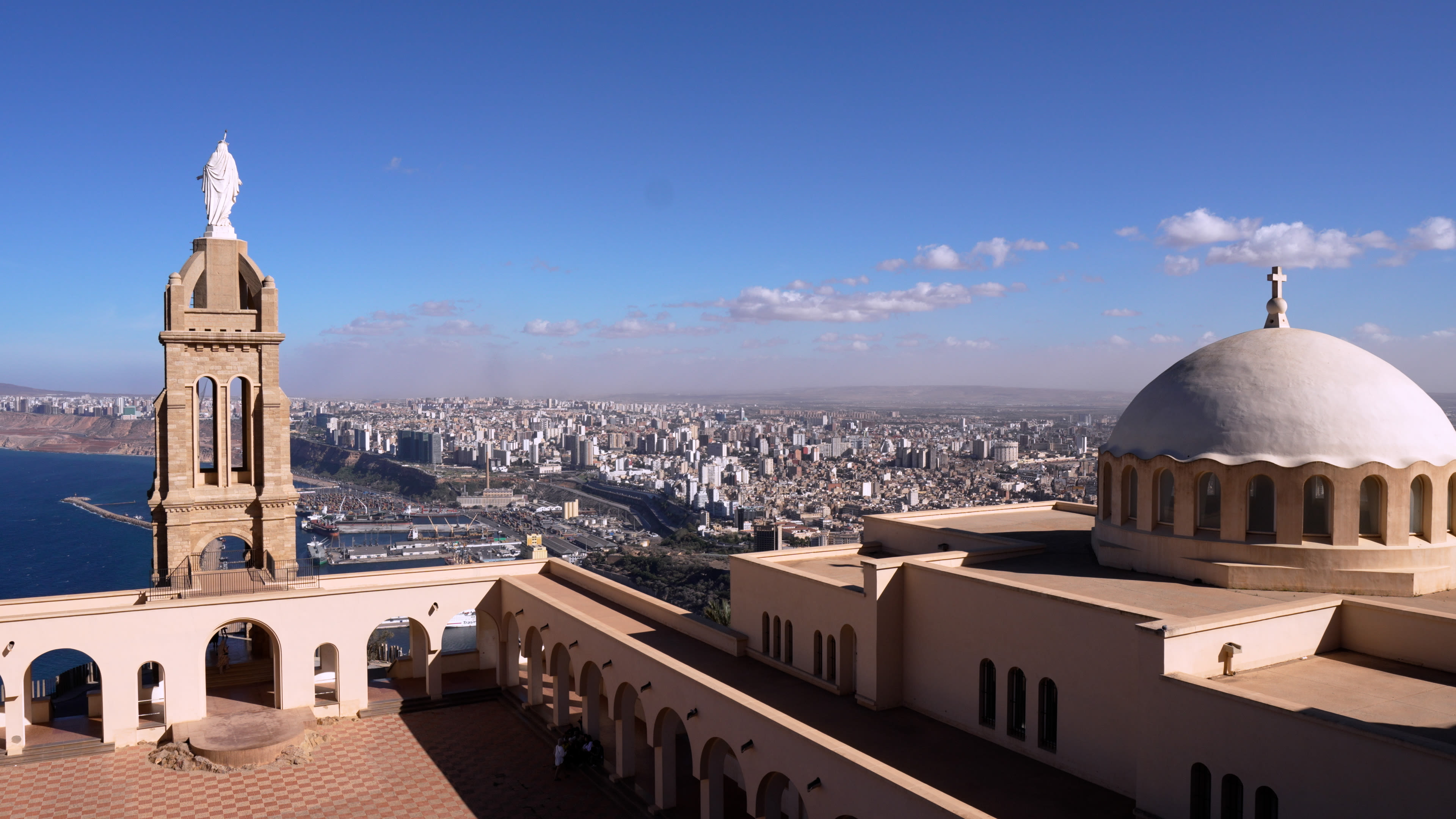
In Oran, Algeria’s second-largest city, the former Cathedral of the Sacred Heart, once one of the city’s most prominent Christian landmarks, has been converted into a public library, though a towering statue of the Virgin Mary still recalls the city’s Christian past.
Elsewhere, testimonies of faith continue. At the convent of the Little Sisters of the Poor, nuns care for dozens of elderly men and women, most of whom are Muslim. A small mosque even stands within the convent grounds to serve them.
The documentary also features Bishop Davide Carraro, who speaks of the resilience of the Church in Algeria. He serves as bishop of Oran following his predecessor, Pierre Claverie, who was assassinated by Islamist extremists in 1996.
Carraro reflects on how the presence of some 300 faithful in what he calls a “listening Church,” surrounded by millions of Muslims, helps Christians deepen their faith.
In Algiers, Augustinian sisters bear witness through their work nursing the sick in hospitals. They chose not to leave the country during its darkest moments, continuing their service even after losing two of their sisters to violence.

The ‘Black Decade’
The documentary also recalls Algeria’s traumatic experience with extremist violence during the 1990s, known as the “Black Decade,” when nearly 200,000 civilians were killed, including Christian clergy and Muslims alike. It notes the government’s efforts to dismantle extremist groups and its determination to prevent their return.
‘Bishop of all Algerians’
Cardinal Jean-Paul Vesco, archbishop of Algiers, says he does not see himself as the bishop of Christians alone but of all Algerians. He emphasized that the Church does not seek to convert the Muslim majority but rather “to show the world that we worship the same God and can be brothers and sisters.”
An inspiring experience
For his part, Flynn described his experience working on the documentary in Algeria as both inspiring and humbling.
Speaking to ACI MENA, the Arabic-language sister service of EWTN News, he said it made him realize “how simple it is for us to practice our faith in our own countries, compared with the great effort required to do the same there.” He praised the Catholic Church’s commitment to preserving its presence and witness in Algeria.
The documentary can be viewed here:
This story was first published by ACI MENA, the Arabic-language sister service of EWTN News, and has been translated for and adapted by EWTN News English.
If you value the news and views Catholic World Report provides, please consider donating to support our efforts. Your contribution will help us continue to make CWR available to all readers worldwide for free, without a subscription. Thank you for your generosity!
Click here for more information on donating to CWR. Click here to sign up for our newsletter.
Leave a Reply
You must be logged in to post a comment.