
The recent restoration of a fresco in an ancient baroque church in central Rome, just a short distance from the Spanish consulate and the Italian Parliament, has sparked an unexpected controversy after one of the angels depicted in the restoration bore a striking resemblance to Italian Prime Minister Giorgia Meloni.
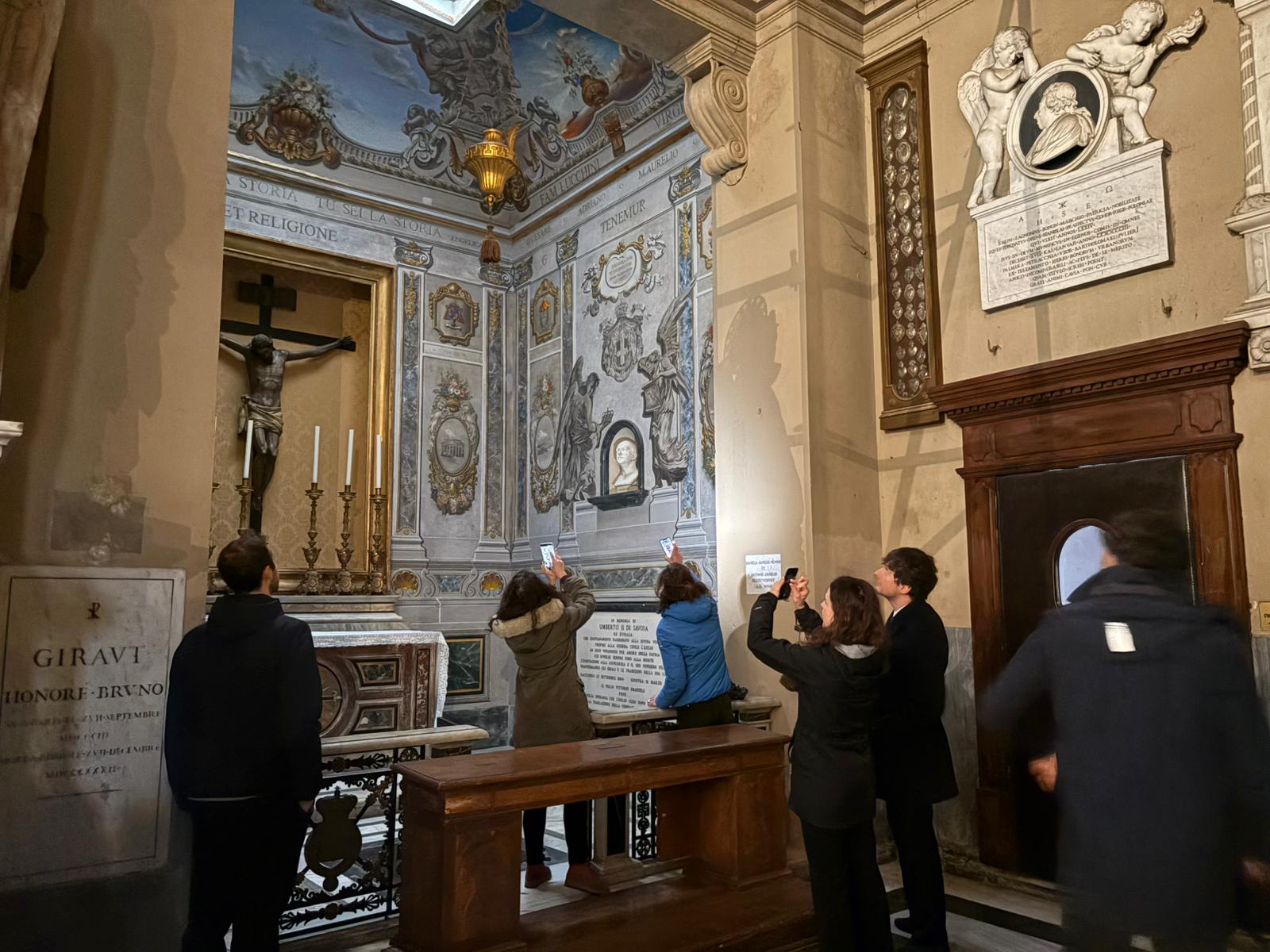
The figure in question holds a scroll with a map of Italy and is one of a pair of angels flanking the marble bust of Umberto II, the last king of Italy, who reigned briefly in 1946. The funerary monument includes the inscription “Acting like a Christian, resigned to the divine will.”
The fresco is located in a side chapel of St. Lawrence Basilica in the Lucina area of Rome, which was built in the fourth century. In recent days, the cherub with features similar to those of Meloni became the focus of unexpected attention from numerous visitors, many of whom came out of curiosity rather than for religious reasons.
The Italian prime minister herself reacted with irony on social media. In a message posted on Instagram, accompanied by a smiling emoji, she wrote: “No, I certainly don’t look like an angel.”
The image unleashed a flood of memes on the internet, where Meloni was even depicted as a version of the Mona Lisa.
However, the fresco is not an ancient work of art but a relatively recent one: It was painted in 2000 as part of the funerary complex dedicated to Umberto II, installed in 1985 at the initiative of the then-parish priest, Pietro Pintus. Over the years, the painting had deteriorated and required restoration.
The person responsible for the restoration was the church’s sacristan, Bruno Valentinetti, 83, who described himself to the Italian media as an amateur painter. Valentinetti insisted that he never intended to portray the prime minister and downplayed the resemblance, attributing it to a coincidence.
On Jan. 31, the parish priest, Father Daniele Micheletti, was one of the first to speak publicly about the matter.
Although he acknowledged the resemblance between the angel and the Italian leader, he initially downplayed the controversy. However, a few hours later, Cardinal Baldassare Reina, vicar of the Diocese of Rome, intervened, distancing himself from those remarks in an official statement.
The cardinal expressed his “deep dismay” over what had happened and announced immediate measures. “It is firmly reiterated that images of sacred art and Christian tradition cannot be subject to improper use or instrumentalization, as they are intended exclusively to support liturgical life and personal and communal prayer,” he stated.
Meanwhile, the church had been transformed into an impromptu tourist attraction, with dozens of people flocking there every day to see and photograph the angel, often for nonreligious reasons — without attending Mass or participating in prayer.
The controversy finally came to an end on the evening of Tuesday, Feb. 3, when according to Italian newspapers, the restorer himself covered over the angel’s face with a layer of white paint. Micheletti later explained that the decision was made because the image had become divisive and because “there was a continuous stream of people coming in just to see it, not to pray or attend Mass; it was impossible to go on like this.”
This story was first published by ACI Prensa, the Spanish-language sister service of EWTN News. It has been translated and adapted by EWTN News English.
Leave a Reply
You must be logged in to post a comment.