
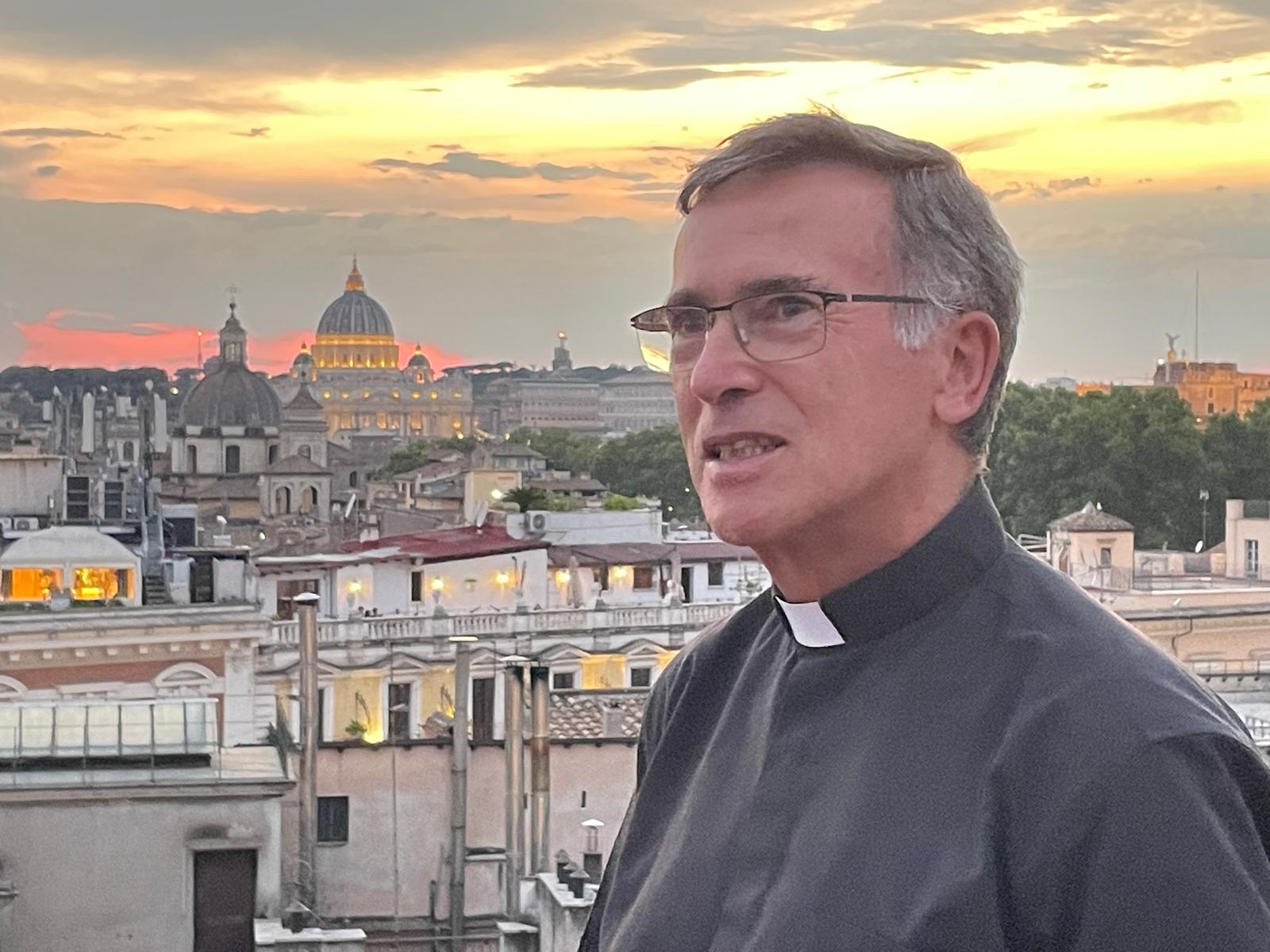
Father Philip Goyret, an ecclesiology professor at Rome’s Pontifical University of the Holy Cross. | Credit: Photo courtesy of Father Philip Goyret
Jan 23, 2026 / 12:04 pm (CNA).
Ecumenical dialogue is especially important in a time when Christian belief and practice are on the decline, said one Catholic expert during the Jan. 18–25 Week of Prayer for Christian Unity.
“What is happening today is that the secularization [of society] is incredibly strong … and the temptation among Christian traditions is to step back,” Father Philip Goyret, an ecclesiology professor at Rome’s Pontifical University of the Holy Cross, told EWTN News.
“But if [Christians] step back, we lose our identity, and we cannot be united,” he said. “That is a serious concern.”
Goyret said it is evident that the theological principles of “unity” and “communion” have become important policies of Leo’s pontificate, as summarized in his papal motto, “In Illo uno unum” (“In the one Christ we are one”).
“Leo, from the very beginning, has said that he wants to be the pope of unity, and that is extremely linked with ecumenism,” he added.
When Leo first stepped out onto the Loggia of Blessings of St. Peter’s Basilica in May last year, he said humanity needs God and stressed the need for a “united Church” in Jesus Christ.
“Therefore, without fear, united hand in hand with God and among ourselves, let us move forward,” the pope said in his May 8 address. “We are disciples of Christ. Christ goes before us. The world needs his light.”
Two months after his election, Pope Leo shed further light on his desire to forge the belief, identity, and mission of the Church.
“I believe very strongly in Jesus Christ and believe that that’s my priority, because I’m the bishop of Rome and successor of Peter, and the pope needs to help people understand, especially Christians, Catholics, that this is who we are,” the pope told the Catholic website Crux in July 2025.
Noting the Holy Father’s particular emphasis on Christian identity and witness as key to advancing ecumenical relations among churches, Goyret said Leo’s predecessors have also shown commitment to promoting unity among the faithful through different approaches.
Pope Francis placed great attention to engaging in dialogue with Eastern and Orthodox Churches, while Pope Benedict XVI is recognized for his 2009 apostolic constitution Anglicanorum Coetibus, which structurally supported Anglicans seeking full communion with the Catholic Church.
“Pope Francis presented himself as ‘bishop of Rome,’ and that’s very significant because that title is the way that Eastern non-Catholic Christians understand the Petrine ministry,” he said, recalling the late pope’s first urbi et orbi address in 2013. “It was an invitation for dialogue.”
By focusing on the Vatican II documents Unitatis Redintegratio (Restoration of Unity) and Lumen Gentium (Light of the Nations), Goyret said Pope Benedict’s approach to ecumenical dialogue encouraged academic study and the faithful living of Christian traditions.
“If you dig and dig into these different traditions, you will eventually discover the Church as Jesus Christ wished it,” he said.
Speaking on the theme of the 2026 Week of Prayer for Christian Unity, “One Body, One Spirit,” Goyret said there is a great need for Christians to be united in prayer and hope to strengthen faith in God in a secularized world.
“Pope Leo said that we have to pray in this Week of Prayer for Christian Unity,” he said. “The Church needs our prayers especially because the unity of the Church is a gift of God.”
“We don’t build it ourselves through negotiation. It’s not diplomatic and it’s not political,” he added. “If we want to restore unity to the Church, we have to ask God for it.”
Leave a Reply
You must be logged in to post a comment.