
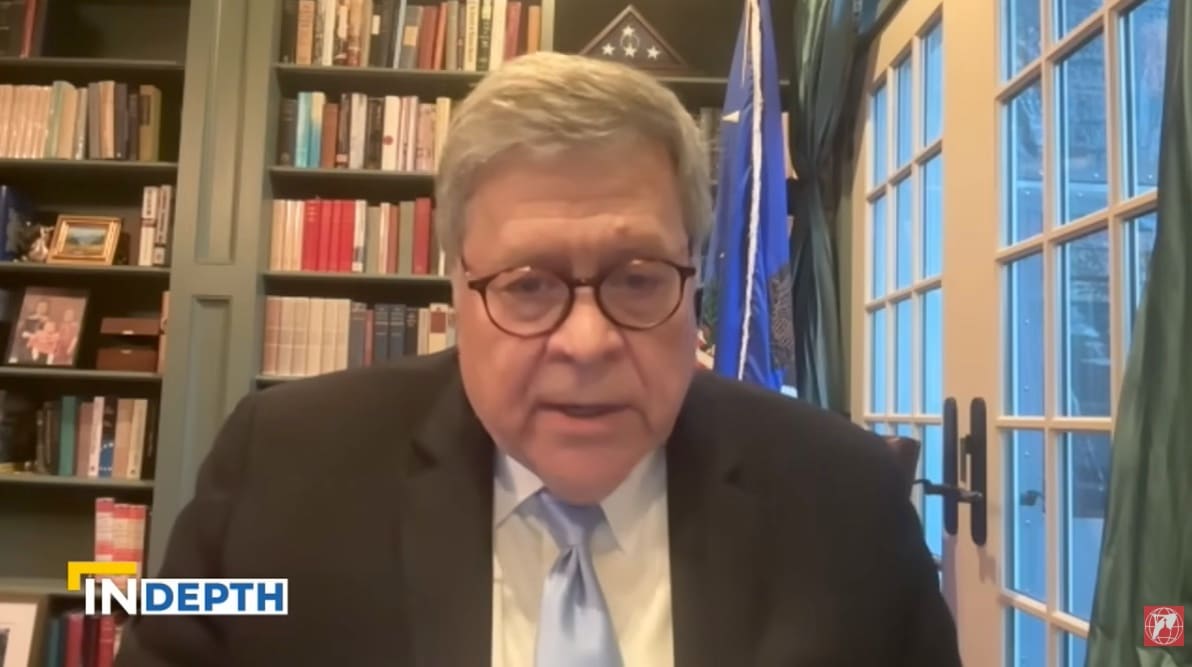
Former U.S. Attorney General Bill Barr speaks with “EWTN News In Depth” on Jan. 9, 2026. | Credit: “EWTN News In Depth”/Screenshot
Jan 12, 2026 / 11:45 am (CNA).
Former United States Attorney General Bill Barr said military action to capture Venezuelan leader Nicolas Maduro was “legitimate under U.S. law.”
On Jan. 3 President Donald Trump announced that U.S. forces “captured” Maduro and his wife, Cilia Flores, and flew them out of the country following a “large-scale strike” on the South American nation.
Since the capture, Congress has remained divided on whether the capture was legal under U.S. and international law. In a Jan. 9 interview with “EWTN News In Depth,” Barr said it was “completely legitimate” under the U.S. Constitution.
Barr served as the 77th attorney general of the United States from 1991 to 1993 under President George H.W. Bush. He was later reappointed as the 85th attorney general from 2019 to 2020 during the first Trump administration.
There are two questions raised in regard to the Maduro situation, Barr said. The first is: “Is it appropriate under American law to use our defense and law enforcement powers the way we did to apprehend Maduro?”
“In my mind, there’s no question that the United States, under our Constitution, had the right to deal with the threat posed by the cocaine trafficking, the drug activities, and the threatening conduct of Maduro’s regime with Cuba, China, and Russia,” Barr said.
The second question is: “Assuming it is legal for the United States to do it, which branch of government should make that call, and is it necessary to have congressional approval?”
“I think the history is very clear that this kind of action, targeted action to deal with a particular threat, is within the discretion of the president,” Barr answered. “Yes, the Congress can declare war, but responding to particular threats, using force, is something that historically virtually all presidents have done.”
Before the raid that captured Maduro, the United States significantly increased its military presence in the Caribbean under Operation Southern Spear and conducted seizures of sanctioned Venezuelan tankers. It conducted drone strikes against suspected narcotics and cartel-linked targets. The military also carried out aerial strikes against civilian boats in the Caribbean resulting in dozens of civilian deaths.
The last time the U.S. deposed a Latin American leader was exactly 36 years ago to the day that Maduro was captured, when U.S. forces captured Gen. Manuel Noriega in Panama. Bush sent troops to arrest, capture, and bring back Noriega for trial.
At the time of Noriega’s capture, Barr was serving as assistant U.S. attorney general and advised the White House on the matter. “There are a lot of parallels” between the situation with Maduro and Noriega, he said.
“We did not recognize Noriega as the legitimate government of Panama because there had been an election, which clearly the democratic forces won, and he suppressed it and remained in power,” Barr said. “Same thing with Maduro. We do not recognize Maduro.”
“Under our law, Maduro is not the leader of the state. Maduro is just a Venezuelan citizen who has seized power and is oppressing the Venezuelan people. That’s how our law views it. And that was the same with Panama.”
In Panama, which is about 12 times smaller than Venezuela, there were already thousands of U.S. troops stationed there when Noriega, who had long-standing ties to the CIA, was taken. A government had been elected legitimately.
Both leaders “were involved heavily in the drug business,” Barr said. “I’d have to say Maduro is much more heavily involved and has repressed his country for over a decade and has destroyed their economy.”
In Venezuela, “a quarter of the country left the country, a quarter of it, 8 million people,” Barr said. “We’re dealing with … a humanitarian crisis. We’re dealing with a country that’s deeply involved in [the] narcotics trade. It was clearly justified, both as a matter of law enforcement and defending the interests of the American people.”
Pope Leo calls for ‘safeguarding the country’s sovereignty’
Venezuela has “a secular socialist government, and they have not protected religious liberty, especially where they view leaders as hostile to the government or not supporting their policies,” Barr said.
“The Catholic bishops down there, I think, issued a statement and made clear that they felt that he had been an oppressive ruler and were relieved to see him ousted from power and that that was a positive step,” Barr said.
“I hope the leaders in Rome pay attention to the position of the Catholic bishops down in Venezuela that have had to deal with it,” he said.
Since the capture, Pope Leo has called for the safeguard of Venezuela’ s sovereignty and that the rule of law in the Constitution is followed.
“Sovereignty is to show respect for the idea that a people should determine their own future,” Barr said. “They should make their own choices, that a people should be able to govern themselves. Now, that applies where you have freedom. But we’re dealing here with a regime that overturned the results of a free election and clearly was not accepted by the people.”
Maduro is “an unpopular dictator who has seized power and turned that country into a piggy bank for his family and for his generals,” Barr said.
“A just war is fought for defensive purposes, to protect the interest, the well-being of your own citizens. Here, you’re dealing with a regime that has been preying on the United States. We indicted him because, and there will be evidence, he’s deliberately trying to weaken and hurt the United States.”
“He’s responsible for tens of thousands, probably hundreds of thousands after all this time, of American deaths,” Barr said. “Our vital interests were at stake. He was providing a base for Hezbollah. He was involved in manufacturing weapons for Iran to use against our allies. He provided a base for Russia and China in his country.”
Next steps
Following Maduro’s capture, people are left wondering if the Trump administration will carry out similar action on other nations. Barr said he does not believe that the U.S. will have to get involved with countries like Cuba or Colombia, because there will be changes without outside intervention.
“Cuba is completely dependent on Venezuelan oil,” he said. “Cuba is so poor because of their socialist regime that they can’t afford to buy oil. What they do is they swap military and intelligence assets and help to the Venezuelans in order to get the oil.”
“I think the oil will be shut down, and I think that that will create a crisis in Cuba, and I think Cuba could very easily fall,” Barr said. In turn, “it also puts pressure on Colombia.”
“The leader of Colombia is the first socialist left-wing leader Colombia has had in over 100 years, and it’s been a disaster for the country. His ratings are extremely low. This is an election year. He cannot succeed himself.”
“I think there’s an opportunity for a change in government there. I don’t think we necessarily have to do anything there. I think that will come,” he said.
Leave a Reply
You must be logged in to post a comment.