
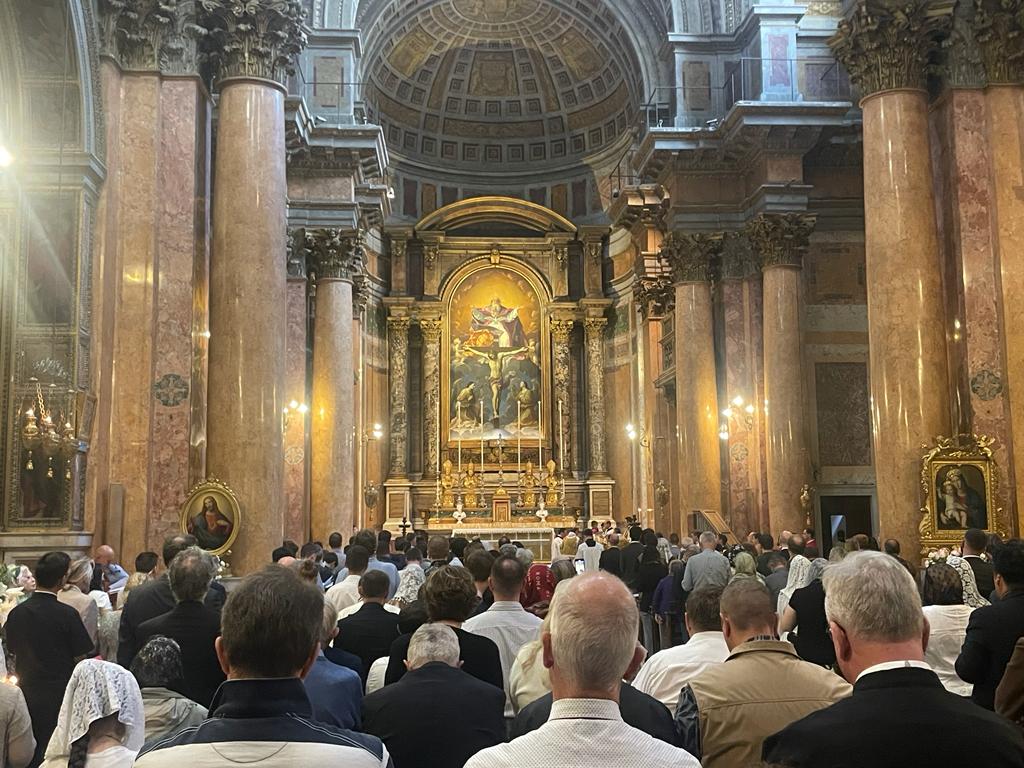
The concluding high Mass for the Summorum Pontificum Pilgrimage, an annual three-day pilgrimage for devotees of the Traditional Latin Mass, on Oct. 29, 2023, celebrated by Bishop Guido Pozzo at the Church of the Most Holy Trinity of the Pilgrims in Rome. | Credit: Andrea Zuffellato
Jan 7, 2026 / 10:37 am (CNA).
As cardinals gather this week in an extraordinary consistory convened by Pope Leo XIV on Jan. 7–8, a French traditionalist priest has sent a memorandum to members of the Sacred College of Cardinals proposing the creation of an ecclesiastical jurisdiction specifically structured to oversee the celebration of the Traditional Latin Mass in an effort to resolve the liturgical crisis that has marked the Church in recent years.
The letter, dated Dec. 24, 2025, and made public by U.S. journalist Diane Montagna, was written by Father Louis-Marie de Blignières, founder of the Fraternity of St. Vincent Ferrier in 1979 and a senior figure of the post-1988 Ecclesia Dei movement who took part in dialogue with St. John Paul II following Archbishop Marcel Lefebvre’s illicit episcopal consecrations.
“Before the consistory, where liturgy will be on the agenda, I take the filial liberty of addressing this short memorandum to you,” de Blignières, 76, wrote at the outset, explaining that his purpose is to suggest “an ecclesial solution that could provide a stable framework for these faithful who are in full communion with the Catholic hierarchy and attached to the ancient Latin rite.”
In practical terms, de Blignières proposes the creation of a new Church structure — such as a personal apostolic administration or an ordinariate — similar to a diocese but not tied to a specific territory. Instead of being organized by geography, it would bring together priests and faithful attached to the traditional Latin liturgy under a single authority wherever they are located.
De Blignières pointed to existing canonical models, particularly military ordinariates, which exercise what canon law calls “cumulative jurisdiction.” Under this arrangement, priests and faithful attached to the traditional rite would belong to the new jurisdiction while remaining members of their local dioceses. Diocesan bishops would therefore not be bypassed but would share pastoral responsibility with bishops appointed to oversee the proposed structure.
According to the letter, this would allow bishops familiar with the 1962 liturgical books to oversee ordinations, confirmations, and other rites specific to the traditional liturgy while relieving diocesan ordinaries who may feel unprepared or reluctant to manage these matters. For the faithful, it would offer clarity and continuity in a context that has often been marked by uncertainty and conflict.
“For more than 60 years, this group has continued to exist and to grow, but it lacks the support of a juridical framework adapted to its legitimate needs,” de Blignières wrote. “The creation of dedicated ecclesiastical jurisdictions would move matters forward toward stability, peace, and unity.”
The proposal comes amid renewed tensions following Pope Francis’ 2021 motu proprio Traditionis Custodes, which significantly restricted the celebration of the Traditional Latin Mass and reversed the more permissive regime established under Benedict XVI’s 2007 motu proprio Summorum Pontificum.
Implementation of Traditionis Custodes has varied widely across dioceses. In some places, bishops have sought pragmatic arrangements to preserve coexistence. In others, traditional communities and liturgical celebrations have been heavily reduced or suppressed. Critics of the current situation argue that this uneven application has contributed to pastoral instability and deepened divisions within the Church, particularly in France and the U.S.
De Blignières framed his proposal not as a challenge to papal authority but as an attempt to offer a constructive way forward. In his view, the absence of a stable juridical solution since the end of the postconciliar liturgical reform has left communities attached to the older rite in a recurring state of vulnerability.
Following the illicit episcopal consecrations carried out by Lefebvre in 1988, the Holy See created the Pontifical Commission Ecclesia Dei to facilitate the reconciliation of communities attached to the liturgy in use prior to the postconciliar reform.
Over the decades that followed, various proposals were already advanced to provide a more stable canonical framework for these communities. One such solution was adopted in 2002 with the establishment of the Personal Apostolic Administration Saint John Mary Vianney in Campos, Brazil, which was granted the faculty to celebrate the sacraments according to the 1962 Roman rite. Other initiatives, including petitions from lay associations such as Una Voce in the United States, did not result in comparable structures elsewhere.
Father Matthieu Raffray, superior of the European District of the Institute of the Good Shepherd and a popular public figure among the youth, commented on the proposal in an interview with Montagna, describing it as a constructive contribution rather than a demand. In his view, the proposal seeks to move beyond what he calls a “sterile” opposition by offering an institutional solution capable of preserving ecclesial communion while recognizing the distinct pastoral reality of communities attached to the vetus ordo.
Other Church figures, however, have already expressed reservations.
Father Pierre Amar, a priest of the Diocese of Versailles near Paris who is also well known on social media, claimed that while a dedicated jurisdiction is “one solution,” it is “not the best one” in his view, warning that it could “isolate traditionalists within a structure, where contact and interaction are a source of enrichment for everyone.”
The letter was sent to a number of cardinals known for their interest in liturgical questions — 15 by post and approximately 100 by email — but not directly to Pope Leo XIV. Its author presented it explicitly as a contribution to reflection ahead of the consistory rather than as a formal request.
Leave a Reply
You must be logged in to post a comment.