
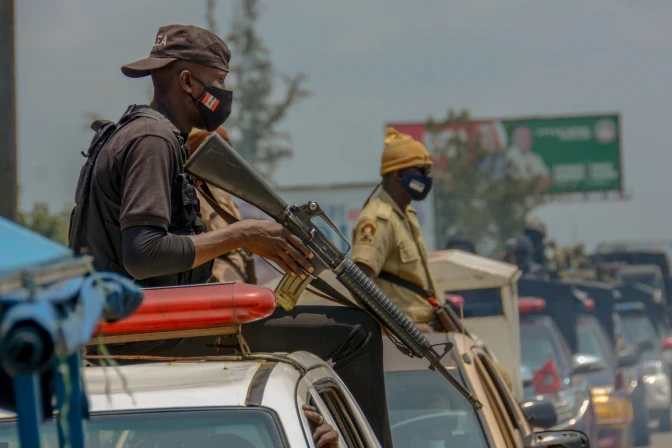
Nigerian security officers during a military operation ahead of the gubernatorial elections in Benin City, Edo, Nigeria, on Sept. 17, 2020. | Credit: Oluwafemi Dawodu/Shutterstock
Jan 2, 2026 / 08:00 am (CNA).
Following U.S. military strikes on Christmas, targeted sanctions and further U.S. action to end persecution of Christians is expected in Nigeria in 2026, according to members of Congress and advocates familiar with the situation.
Rep. Riley Moore, R-West Virginia, has said he will present a report to U.S. President Donald Trump that “outlines concrete ways the United States can partner with Nigeria to bring an end to this bloodshed and protect our brothers and sisters in Christ.”
Moore’s office said the congressman would meet with Trump sometime in January and present him a report including 30 possible ways the administration could act to end the persecution of Christians in Nigeria in accordance with Trump’s designation of Nigeria as a country of particular concern (CPC).
“During my trip to Nigeria, I met many who had endured unimaginable suffering — women who had watched their children and loved ones brutally murdered in front of them,” Moore said in a statement. “At the same time, our engagement with Nigerian leaders was productive, and we are close to establishing a strategic security framework to confront both ISIS and Boko Haram in the northeast and to stop the targeted violence against Christians in the Middle Belt by Muslim Fulani radicals.”
“I am grateful to President Trump for entrusting me with leading this official House investigation,” he said. “The report I will present to the president outlines concrete ways the United States can partner with Nigeria to bring an end to this bloodshed and protect our brothers and sisters in Christ.”
Trump had threatened military action against Nigeria shortly after announcing the designation. He said in a social media post Nov. 1 if the Nigerian government fails to stop the killing of Christians, “the U.S.A. will immediately stop all aid and assistance to Nigeria, and may very well go into that now disgraced country, ‘guns-a-blazing,’ to completely wipe out the Islamic terrorists who are committing these horrible atrocities.” He has since threatened further military action following the Christmas Day strikes.
After the Dec. 25 strike, Trump said in a statement that he “warned these terrorists that if they did not stop the slaughtering of Christians, there would be hell to pay, and tonight, there was.”
Moore’s forthcoming report follows his travel to Nigeria’s Middle Belt region, where he met with Christians who fled from persecution and are living in camps of displaced people. The president had charged Moore with looking into the situation in Nigeria and reporting back to him.
Nina Shea, Hudson Institute senior fellow, said she hopes the recent strikes on ISIS will further embolden the Nigerian government to police Islamist Fulani militants in the region, including by confiscating their AK assault weapons.
“These Fulani have observed the free rein given to the terror groups until now and act as though they too have a license to massacre and kidnap Christians,” she said. “Trump now has the attention and cooperation of the Nigerian government in addressing this crisis before it’s too late.”
The president can choose from a menu of sanctions for a CPC-designated country under the International Religious Freedom Act (IRFA) of 1998, ranging from diplomatic measures to economic sanctions.
Under the IRFA, the U.S president must designate countries that engage in or tolerate “particularly severe violations of religious freedom” as CPCs. Violations include torture, prolonged detention without charges, and forced disappearance, according to the State Department.
Shea said she expects the outcome of the CPC designation in 2026 to entail the return of Middle Belt Christians to their homelands with ongoing protection from “an effective security force.” Shea said she further expects to see the U.S. government assist Nigeria in its border security “to stop the influx of Islamist terrorists and weapons from the Sahel,” and for the U.S. government to impose visa sanctions against “Nigerian officials and individuals who are complicit in the atrocities linked to religious freedom violations.”
“The stakes for Christians are very high,” Shea said.
Sean Nelson, senior counsel for global religious freedom with Alliance Defending Freedom International, said he’s “cautiously hopeful” for the outcome of the CPC designation in 2026. “This is really the most I’ve ever seen in terms of D.C. action in order to really try to resolve and fix what is one of the worst persecutor situations in the world,” Nelson said.
For his work with ADF, Nelson said his focus regarding Nigeria in 2026 will be ADF’s challenge of blasphemy laws at the Supreme Court of Nigeria that allow punishment by death.
Leave a Reply
You must be logged in to post a comment.