
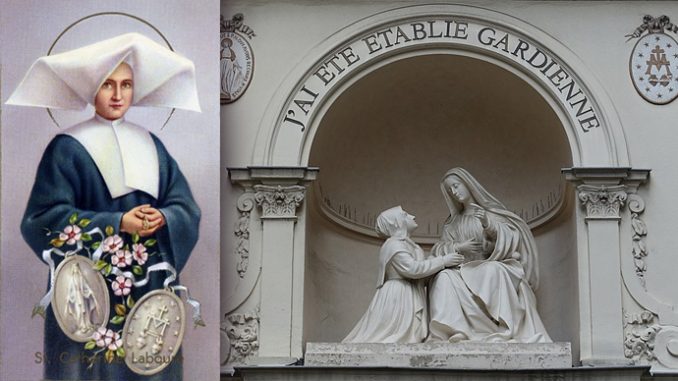
Saint Catherine Labouré (1806-76) is best remembered as the recipient of a series of visions involving the Miraculous Medal. But we must not overlook the context in which she received those visions.
In the late eighteenth century, the French Revolution unleashed a decade of terror, executions, war, and starvation upon France. A major goal of the revolutionaries was to eradicate the Catholic Church, and for a time, they seemed to succeed. But over the next century, the Holy Spirit rebuilt the Church in France through the saints.
Nineteenth-century French saints include two of the greatest saints in the history of the Church—Saint Jean Vianney and Saint Thérèse of Lisieux—as well as Saint Bernadette Soubirous. Many other holy women and men founded religious orders to educate children,1 care for the poor,2 and encourage devotion among the laity.3
But Zoé Labouré (1806-1876) had her own role in restoring faith in Jesus Christ in France.
Zoé’s father’s farm was one of the most prosperous in their village in eastern France, and she was born the ninth child in a large family. She was particularly close to her devout mother, who died suddenly when Zoé was nine years old. Some of the older children had left home by then, but the three youngest children, including Zoé, seemed to be lost in their grief. Her father, Pierre, sent them to live with an aunt. The children spent almost three years in that happy home before Pierre asked them to return.
Zoé’s older sister, Marie Louise, had been running the Labouré home since her mother died, but now she wanted to become a religious sister. Pierre agreed to allow this only if she trained twelve-year-old Zoé to take her place.
Zoé agreed—not that she was really given a choice in the matter—and learned how to run a household. That household included her father, three brothers (one of whom was an invalid), and a younger sister named Tonine. It also included more than a dozen hired men who worked the family farm. Cooking, feeding, cleaning, planning, and shopping for her family and for many hungry men, along with other farm chores, was more than a full-time job. After Zoé had demonstrated her ability to manage the household, Marie Louise left for the convent. Zoé was a matter-of-fact, hard-working teenager. And she was devout.
After her mother’s death, Zoé had turned to the Mother of God for comfort. One day, she quietly found a statue of the Blessed Mother in her parents’ bedroom. As she explained later, she had to stand on a chair to take it down from its shelf, but then she hugged it close and announced aloud, “Now, dear Blessed Mother, … now you will be my mother!”4
Later, at the age of eighteen, she had a remarkable dream. In that dream, she was in her parish church, watching an elderly priest celebrate Mass. After Mass, the priest beckoned for her to follow him, but instead, she ran away. When she stopped at the home of a sick woman, the priest appeared again. He told her, “You flee from me now, but one day you will be glad to come to me. God has plans for you, do not forget it.”5
However, Zoé did not spend her teenage years waiting for more visions. Her sister Tonine noticed that Zoé’s love for our Lord deepened markedly after she received her First Holy Communion. Zoé began attending daily Mass and caring for sick people in her village. Her father should not have been surprised when she told him that she wanted to become a religious sister. But he doted on Zoé and did not want to lose her to religious life.
Pierre sent Zoé to live with one of her brothers, who ran a tavern. Zoé obediently and uncomplainingly served food to coarse workmen in Paris until other members of the family decided to intervene. A cousin convinced Pierre to let Zoé attend her school. While Zoé tried (and failed) to learn to read and write, she also happened to visit a community of the Sisters of Charity, which had been founded by Saint Vincent de Paul. That’s where she saw a painting of the famous French saint and recognized him as the priest from her dream.
Pierre was stubborn, but so was his daughter. Although he refused to provide the dowry for her to enter the Sisters of Charity, he did eventually give his consent. Other family members provided the money. Zoé entered the Sisters’ community on the street of Rue de Bac in Paris when she was twenty-four years old and took the name of Catherine.
The same month that she entered, the relics of Saint Vincent de Paul were translated to a nearby Vincentian church. Catherine, still a novice, prayed daily with other members of her community at the church. One night while praying a novena, she saw the relic of Saint Vincent’s heart change to a fleshy white color. The next night, it appeared to be fiery red, and on the third night, it appeared to be dark red. She interpreted this color change to mean that there would be a change in the French government. (She was right.)
A few months later, she received a vision of Jesus Christ as King and received another inspiration that the French king, Charles X, would lose his throne. (She was also right about that.)
The next month, on the eve of the feast of Saint Vincent de Paul, Catherine experienced a great sense of peace. Late at night, a beautiful, shining child woke her from sleep and brought her to the community’s chapel. After waiting in the brightly lit chapel, Our Lady appeared and told her, “My child, the good God wishes to charge you with a mission.”6 They talked for two hours.
Catherine received other visions in 1830. The Blessed Virgin appeared to Catherine holding a golden ball, which she raised up to God, and Catherine was told to have a statue made according to that vision. In another apparition, Catherine saw the two sides of a medal, and she was told to have medals struck with those images.
Catherine immediately shared her visions with her spiritual director, Father Jean Marie Aladel. The priest struggled to believe that a young novice who had only recently entered the order could be receiving visions. But Catherine was not timid, and she did not change her story. After almost two years, he stopped telling her she was delusional and had medals made according to the pattern she described. For unclear reasons, he did not pursue plans to create the statue, which was only completed after Catherine’s death.
The rest, of course, is history. These medals became known as Miraculous Medals because of the number of miracles with which they were associated. The most famous miracle involved Alphonse Ratisbonne, an anti-Catholic French lawyer who converted and became a Jesuit priest after wearing one.
While the medals and Fr. Aladel’s written account of the vision became famous, Catherine happily remained unnoticed. She performed her assigned duties and spent most of the forty-six years of her religious life caring for elderly men in a home directed by the Sisters. Catherine knew how to deal with rascally and sometimes inebriated men, make sacrifices for her patients, efficiently run a large household, and even remain humbly obedient when she had to obey a less-efficient superior.
There were about 150 religious sisters in Catherine’s community, and everyone knew that one of them was the famous visionary described by Fr. Aladel. Obviously, there was endless speculation about the identity of the visionary, and Sister Catherine was a popular contender. Over the years, they noticed Catherine’s prayerfulness, quiet wisdom, and down-to-earth virtue. They tried to bait her into revealing that she was the famous visionary. She never told them the truth, but she somehow managed never to lie either.
Catherine received other visions. About a year after the vision of the Miraculous Medal, the Blessed Mother appeared to her, stated that this was the last time Catherine would see her, and told her that “you will hear my voice in your prayers.”7 Almost two decades later, Catherine received a vision of Jesus Christ with the Crown of Thorns on His head and believed that the vision had symbolic meanings about the future of France. After Catherine’s death, the Sisters also remembered that she sometimes made brief but accurate predictions about major events. She clearly received other heavenly insights.
Like all private revelations, Catholics are free to accept or set aside the contents of Catherine’s visions. But the timing of her visions is interesting.
Beginning in 1830, the message that Catherine saw—“O Mary, conceived without sin, pray for us who have recourse to you”—began to spread all over the world through the medals. Twenty-four years later, Pope Pius IX declared the dogma of the Immaculate Conception of Mary. Four years after that, Saint Bernadette Soubirous experienced eighteen visions of Mary, confirming the same teaching. Note that both visionaries were illiterate French peasants who never sought fame for themselves.
Despite what Catholics and non-Catholics might think, God does not appear to grant important visions to dreamy, overly emotional, or high-powered individuals so that they can brag about them to their friends. Instead, He seems to prefer devout, long-suffering, obedient, tight-lipped individuals for His most significant messages. The more important the message, the humbler the messenger.
For example, it was the Patriarch Jacob’s overlooked son Joseph who received visions and who eventually saved his family during a time of famine—and who probably later regretted telling his older brothers about his remarkable dreams.
Saint Catherine only revealed to her superior that she was the recipient of the famous visions when she realized that she was about to die. Through her faithful communication of the visions and her decades of silence—letting the message become famous, not the messenger—she helped to restore faith in God to the people of France, a renewed faith which then spread all over the world.
In that way, Saint Catherine Labouré is simply a handmaid of the greatest handmaids of the Lord, a young virgin who also knew when to speak and when to be silent. Mary too was patient, humble, and remained silent about her vision of an angel for many years. And that is why she became the Mother of God.
Endnotes:
1 For example, Saint Marcellin Champagnat founded the Marist Brothers.
2 For example, Saint Jeanne Jugan founded the Little Sisters of the Poor.
3 For example, Blessed Pauline Jaricot founded multiple lay associations.
4 Joseph I. Dirvin, CM, Saint Catherine Laboure of the Miraculous Medal (Charlotte: TAN Books, 1984), 16.
5 Ibid, 36.
6 Ibid, 83.
7 Ibid, 111.
If you value the news and views Catholic World Report provides, please consider donating to support our efforts. Your contribution will help us continue to make CWR available to all readers worldwide for free, without a subscription. Thank you for your generosity!
Click here for more information on donating to CWR. Click here to sign up for our newsletter.
Leave a Reply
You must be logged in to post a comment.