
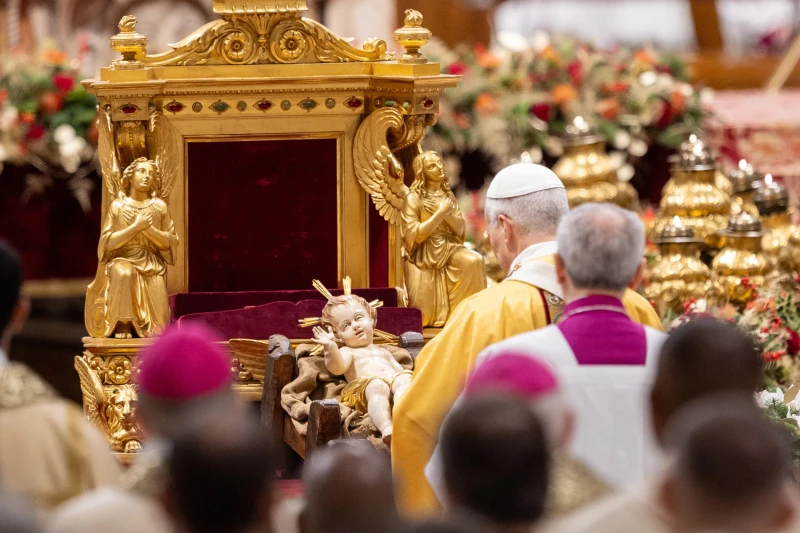
 Pope Leo XIV venerates a statue of the Child Jesus during the celebration of Christmas Mass during the Night in St. Peter’s Basilica on Dec. 24, 2025. / Credit: Daniel Ibanez/CNA.
Vatican City, Dec 24, 2025 / 17:31 pm (CNA).
Pope Leo XIV celebrated Christmas Mass during the Night in St. Peter’s Basilica on Wednesday. The Mass was attended by an estimated 6,000 people inside the basilica, while around 5,000 people gathered outside in St. Peter’s Square, according to the Vatican.
Below is the full text of the pope’s Christmas night homily:
Dear brothers and sisters,
For millennia, across the earth, peoples have gazed up at the sky, giving names to the silent stars, and seeing images therein. In their imaginative yearning, they tried to read the future in the heavens, seeking on high for a truth that was absent below amidst their homes. Yet, as if grasping in the dark, they remained lost, confounded by their own oracles. On this night, however, “the people who walked in darkness have seen a great light; those who dwelt in a land of deep darkness, on them has light shined” (Is 9:2).
Behold the star that astonishes the world, a spark newly lit and blazing with life: “To you is born this day in the city of David a Savior, who is the Messiah, the Lord” (Lk 2:11). Into time and space — in our midst — comes the One without whom we would not exist. He who gives his life for us lives among us, illuminating the night with his light of salvation. There is no darkness that this star does not illumine, for by its light all humanity beholds the dawn of a new and eternal life.
It is the birth of Jesus, Emmanuel. In the Son made man, God gives us nothing less than his very self, in order to “redeem us from all iniquity and purify for himself a people of his own” (Titus 2:14). Born in the night is the One who redeems us from the night. The hint of the dawning day is no longer to be sought in the distant reaches of the cosmos, but by bending low, in the stable nearby.
The clear sign given to a darkened world is indeed “a child wrapped in bands of cloth and lying in a manger” (Lk 2:12). To find the Savior, one must not gaze upward, but look below: the omnipotence of God shines forth in the powerlessness of a newborn; the eloquence of the eternal
Word resounds in an infant’s first cry; the holiness of the Spirit gleams in that small body, freshly washed and wrapped in swaddling clothes. The need for care and warmth becomes divine since the Son of the Father shares in history with all his brothers and sisters. The divine light radiating from this Child helps us to recognize humanity in every new life.
To heal our blindness, the Lord chooses to reveal himself in each human being, who reflect his true image, according to a plan of love begun at the creation of the world. As long as the night of error obscures this providential truth, then “there is no room for others either, for children, for the poor, for the stranger” (Benedict XVI, Homily, Christmas Mass during the Night, 24 December 2012).
These words of Pope Benedict XVI remain a timely reminder that on earth, there is no room for God if there is no room for the human person. To refuse one is to refuse the other. Yet, where there is room for the human person, there is room for God; even a stable can become more sacred than a temple, and the womb of the Virgin Mary become the Ark of the New Covenant.
Let us marvel, dear brothers and sisters, at the wisdom of Christmas. In the Child Jesus, God gives the world a new life: his own, offered for all. He does not give us a clever solution to every problem, but a love story that draws us in. In response to the expectations of peoples, he sends a child
to be a word of hope. In the face of the suffering of the poor, he sends one who is defenseless to be the strength to rise again. Before violence and oppression, he kindles a gentle light that illumines with salvation all the children of this world. As Saint Augustine observed, “human pride weighed
you down so heavily that only divine humility could raise you up again” (Saint Augustine, Sermon 188, III, 3). While a distorted economy leads us to treat human beings as mere merchandise, God becomes like us, revealing the infinite dignity of every person. While humanity seeks to become “god” in order to dominate others, God chooses to become man in order to free us from every form of slavery. Will this love be enough to change our history?
The answer will come as soon as we wake up from a deadly night into the light of new life, and, like the shepherds, contemplate the Child Jesus. Above the stable of Bethlehem, where Mary and Joseph watch over the newborn Child with hearts full of wonder, the starry sky is transformed into “a multitude of the heavenly host” (Lk 2:13). These are unarmed and disarming hosts, for they sing of the glory of God, of which peace on earth is the true manifestation (cf. v. 14). Indeed, in the heart of Christ beats the bond of love that unites heaven and earth, Creator and creatures.
For this reason, exactly one year ago, Pope Francis affirmed that the Nativity of Jesus rekindles in us the “gift and task of bringing hope wherever hope has been lost,” because “with him, joy flourishes; with him, life changes; with him, hope does not disappoint” (Homily, Christmas Mass during the Night, 24 December 2024). With these words, the Holy Year began. Now, as the Jubilee draws to a close, Christmas becomes for us a time of gratitude and mission; gratitude for the gift received, and mission to bear witness to it before the world. As the Psalmist sings: “Tell of his salvation from day to day. Declare his glory among the nations, his marvelous deeds among all the peoples” (Ps 96:2–3).
Brothers and sisters, contemplation of the Word made flesh awakens in the whole Church a new and true proclamation. Let us therefore announce the joy of Christmas, which is a feast of faith, charity and hope. It is a feast of faith, because God becomes man, born of the Virgin. It is a feast of charity, because the gift of the redeeming Son is realized in fraternal self-giving. It is a feast of hope, because the Child Jesus kindles it within us, making us messengers of peace. With these virtues in our hearts, unafraid of the night, we can go forth to meet the dawn of a new day.
Leave a Reply
You must be logged in to post a comment.