
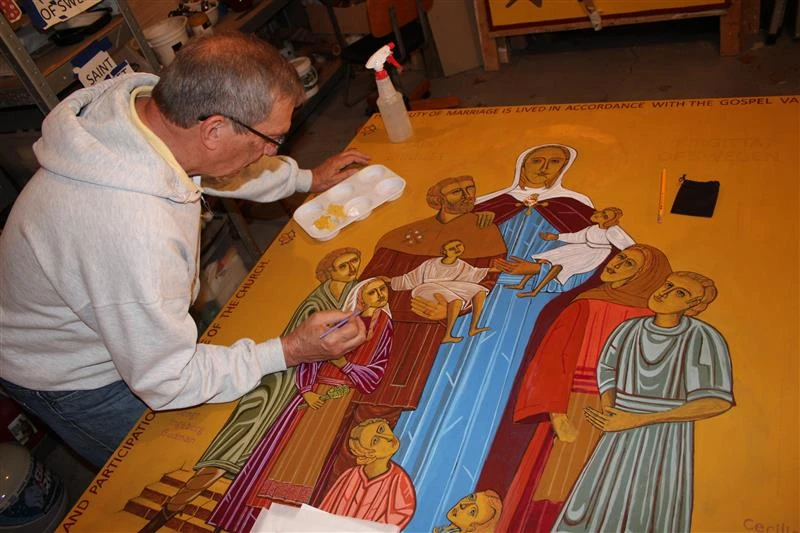
Father Richard Reiser, an iconographer based in Omaha, Nebraska, writes an icon of St. Bridget of Sweden with her family for FOCCUS Marriage Ministries’ 40th anniversary. / Credit: Photo courtesy of FOCCUS
CNA Staff, Dec 13, 2025 / 06:00 am (CNA).
When an iconographer began his work on a unique icon, he looked to the bones of the saint’s husband for help.
FOCCUS Marriage Ministries, a Catholic marriage ministry, invited the priest-iconographer Father Richard Reiser to make an icon of St. Bridget of Sweden, a mystic and the mother of eight. The ministry is celebrating its 40th anniversary this year and chose St. Bridget to be the patron saint of its work.
But there was one challenge. According to Reiser, historically there is no established iconographic prototype of an icon of St. Bridget of Sweden.
So using his imagination and every historical source available — including the bones of St. Bridget’s husband — the priest developed an entirely new icon of a saint who has gone without an icon for hundreds of years.
The domestic church
“For me, iconography is first and foremost a form of prayer,” Reiser said. “The entire creative process is an act of listening to God and allowing the sacred story of a saint or mystery to take shape through layers of contemplation, color, and symbolism.”
The end result was an icon ripe with symbolic meaning — at its heart, marriage and family.

FOCCUS Marriage Ministries chose St. Bridget of Sweden to be its patron because of her commitment to marriage and the Church.
St. Bridget’s life “beautifully reflects the heart of marriage ministry,” Sheila Simpson, who heads the archdiocese-owned nonprofit, told CNA.
Now displayed in the hallway of the FOCCUS office in the Archdiocese of Omaha, Nebraska, the icon contains a quote from Pope Benedict XVI about the family as the domestic church as well as several symbols of the married couple’s life together.
“The icon quietly teaches that marriage is both a covenant of grace and a living witness to the Gospel,” Reiser told CNA.
With St. Bridget as its guiding light, FOCCUS is launching resources for couples whose marriages have unusual challenges, such as those who need their marriage convalidated by the Church, as well as those marrying later in life.
FOCCUS is most well known for its inventories — questionnaires designed to help engaged couples prepare for marriage by initiating conversations about issues like finance and values. The additional, new questionnaires will have questions tailored for couples in unusual situations, including military couples, first responders, and deacons.
Simpson said many couples say FOCCUS “became a turning point — not because it told them what to do, but because it helped them truly hear each other.”
Windows into the divine
Reiser said that one of the most “fascinating” parts of the icon-making process was consulting the bones of Ulf Gudmarsson, the husband of St. Bridget.
“His bones indicated that he was significantly larger in stature than she was,” he said.
“To honor historical accuracy while still emphasizing Bridget’s spiritual prominence, I placed her on a small set of steps so she would remain the central figure of the composition,” he explained.
Icons are “created for contemplation and spiritual truth more than realism,” Reiser said.
“They are windows into the divine — visual theology meant to open the heart and mind to God’s presence,” he continued.
“They participate in the mystery of the Incarnation,” Reiser said. “The eternal Word of God takes visible form.”
The icon depicts an emblem of the Third Order Franciscans, which the couple joined after they got married.
In addition, Gudmarsson holds a staff with a shell, referencing the pilgrimage the couple took to northwestern Spain.
It would be the last pilgrimage the couple ever made together. On the return journey from the pilgrimage, Gudmarsson grew ill and died soon after they returned to Sweden.
As a widow, St. Bridget dedicated her life to Christ, founding the religious order now known as the Bridgettines, which still exists to this day.

An icon of family and unity
Iconographers don’t paint — they write.
“Every line, color, and gesture carries symbolic meaning,” Reiser said. “That is why we often say icons are ‘written’ rather than painted.”
For instance, the 15 florets below St. Bridget of Sweden reference her 15 meditations on Christ’s passion. The cloak she wears has a brooch styled to symbolize the five wounds of Christ. Within the brooch is a relic of St. Bridget.
“Writing the icon of St. Bridget of Sweden was a unique and grace-filled experience because, historically, there is no established iconographic prototype of her — especially not one depicting her with her family,” Reiser said. “Without a traditional image to follow, I drew from existing paintings of St. Bridget and shaped them within the contemplative, dignified structure of classical iconography.”
With “no established icon tradition for Bridget’s family,” Reiser said he “consulted other family-centered icons, especially images of Christ with children, to discern how to portray children in an authentically iconographic style.”
The paintings of the children visually form a circle, which Reiser said represents the unity of the family. One of the children, Ingeborg, holds bluebells, the national flower of St. Bridget’s homeland, Sweden.
“Each of these details helps the icon speak not just as artwork but as a theological meditation on the holiness of family life,” Reiser said.
Leave a Reply
You must be logged in to post a comment.