
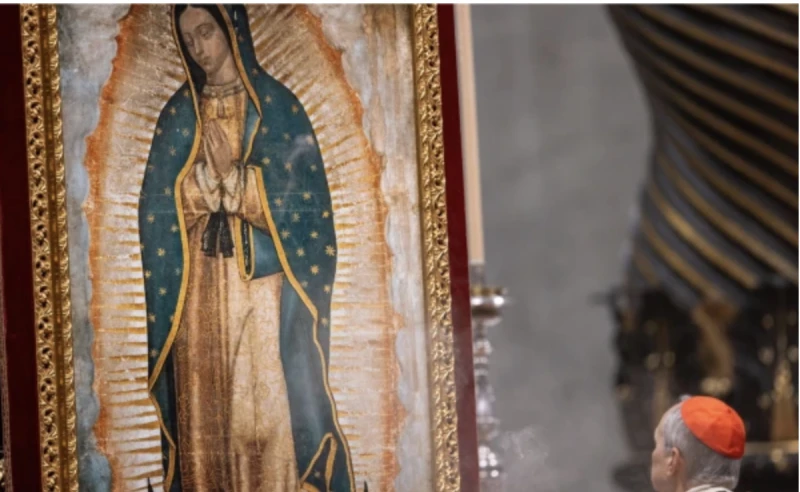
Image of Our Lady of Guadalupe in the Vatican. / Credit: Daniel Ibañez/EWTN News
Vatican City, Dec 11, 2025 / 16:54 pm (CNA).
“Do not let your heart be troubled. Am I not here, I who am your mother?” With this consolation — with which Our Lady of Guadalupe of Mexico addressed St. Juan Diego in December 1531 — a devotion was kindled that, almost five centuries later, continues to shape the spiritual identity of Mexico and all of the Americas.
That same message, simple and profoundly consoling, still has a singular power today, especially “in the context of war and difficulties in the world we live in today,” said Father Stefano Cecchin, OFM, president of the Pontifical International Marian Academy, in an interview with ACI Prensa, CNA’s Spanish-language news partner.
Cecchin will participate on Dec. 12 in an unprecedented gathering organized by the Pontifical Commission for Latin America at the Vatican, a day that will bring together Latin American priests, women religious, and seminarians and will place the figure of Mary — particularly under her title of Our Lady of Guadalupe — at the center of evangelizing reflection.
Guadalupe, a message of closeness and liberation
Cecchin emphasized that Mary manifested herself with accessible, approachable, and protective language, capable of spreading the Christian message without obscuring the Indigenous identity of the visionary. In fact, he emphasized, “in Guadalupe we encounter the inculturation of God.”
For him, the spiritual core of the Guadalupe event is profoundly liberating: “Mary appears not to frighten, even though it occurs at the end of the Aztec calendar year, but she appears to bring peace and serenity. The message of Guadalupe is that whoever is with Mary should not be afraid.”
Understanding this historical and theological dimension, he added, allows us to perceive its universal impact. “We are trying to raise awareness throughout the world, beyond the countries of Latin America, the Philippines, and Spain. We want everyone to embrace it,” he stated. Cecchin summarized its importance with a powerful image: “For us, Guadalupe is the Sinai of the Americas.”
The comparison is not metaphorical: The people of Israel were born on the Sinai Peninsula, and in Guadalupe, Cecchin continued, “the Christian people of the Americas were born.”
Conference in light of new doctrinal document
The day at the Vatican is directed toward Latin American priests, women religious, and seminarians studying in Rome. After greetings from Archbishop Filippo Iannone, the president of the Pontifical Commission for Latin America, Cardinal Víctor Manuel Fernández, prefect of the Dicastery for the Doctrine of the Faith, will speak, offering a keynote address titled “Mary: Star of Evangelization and the Mission for Latin America Today.”
“This expression has been used many times in Latin America, but we want to reconsider it in light of the teaching of the new doctrinal note on the Virgin Mary that the Dicastery for the Doctrine of the Faith has given us,” Rodrigo Guerra, secretary of the Pontifical Commission for Latin America, told ACI Prensa.
Fernández’s presence will be directly linked to the recent publication of the doctrinal note Mater Populi Fidelis, a document that has sparked considerable debate in some quarters by proposing a rereading of popular Mariology and by nuancing traditional devotional titles.
Precisely for this reason, the event on Dec. 12 seeks to offer keys for a serene reception of the document from the perspective of evangelization.
In this regard, Guerra will present a reflection on the doctrinal reception of the figure of Our Lady of Guadalupe in Rome: “I will explain the pleasant surprise we all felt upon discovering that in the recent doctrinal note from the Dicastery for the Doctrine of the Faith, the topic of Our Lady of Guadalupe is addressed in two paragraphs in order to show in a very eloquent way how popular Marian devotion in Latin America today can offer us some lessons in the face of the challenges of evangelization in Latin America.”
Connection between Mary and synodality
Following the prefect’s lecture, a discussion with the participants will take place, followed by an academic panel with three brief presentations. The first will be given by Cecchin, who will address Our Lady of Guadalupe’s contribution to a balanced Mariology.
Afterward, Bishop Luis Marín de San Martín, undersecretary of the Synod of Bishops, will speak to explore deeper the connection between Mary and synodality: a theme that the universal synodal process has highlighted in recent years. He explained to ACI Prensa that when we recognize Mary’s role in ecclesial life and in the devotion of the faithful, “the real need arises to delve deeper into the Marian mystery in order to better understand the synodal and missionary Church.”
He also pointed out that the figure of Mary is “fundamental” in the recovery of women’s identity and their value in the Church. “In her we find the perfect example of a Christian, a disciple. Always prophetically engaged with reality,” the Spanish prelate explained.
The day will conclude with a presentation by Guerra, secretary of the Pontifical Commission for Latin America.
The date — Dec. 12 — is not accidental: It coincides with the feast of Our Lady of Guadalupe and the anniversary of the episcopal ordination of Pope Leo XIV. “That is why we thought this day was a good occasion for us to meet with all the students and friends from Latin America… to take a look at how Mary challenges us and offers us new reasons to rethink evangelization and mission in Latin America today,” Guerra said.
Following the conference, Mass in honor of Our Lady of Guadalupe will take place at 4 p.m. local time in St. Peter’s Basilica, celebrated by Pope Leo XIV. It will be one of the first significant gestures of the new pope toward the Latin American community residing in Rome.
This story was first published by ACI Prensa, CNA’s Spanish-language news partner. It has been translated and adapted by CNA.
Leave a Reply
You must be logged in to post a comment.