
“I Humbly Beg Your Speedy Answer”: Letters on Love and Marriage from the World’s First
Personal Advice Column
Mary Beth Norton (Princeton, $34, 203 pages)
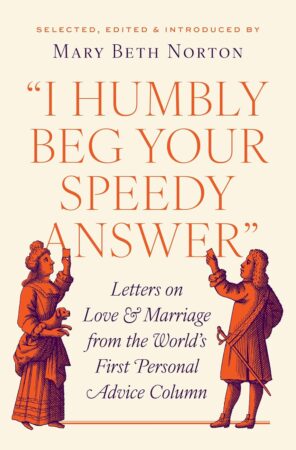 In the 1690s, John Dunton published a two-page broadsheet, the Athenian Mercury, a double-sided broadsheet that was “the world’s first advice column,” answering queries from anonymous writers and responded to by the paper’s
anonymous Athenian Society of experts (Dunton, Samuel Wesley, an Anglican minister, and Richard Sault, a mathematician). The concept was such a success that it doubled production to twice weekly and Dunton republished the
letters and responses in several collected volumes. Mary Beth Norton has collected some of the best questions and
answers in a lovely short volume, “I Humbly Beg Your Speedy Answer”: Letters on Love and Marriage from the World’s FirstPersonal Advice Column. Although The Athenian Mercury handled a broad range of issues, Norton has chosen to focus
this collection on letters addressing gender relations, sex, and marriage. Some of the questions will sound quaint, with
one “gentlewoman” saying her father has told his daughters, “nothing should soon quench the flame of his paternal love
as our deviation from the strict rules of pure chastity and its handmaid, modesty.” Some answers may seem outdated: “Be
the humblest, doting, whining spaniel-thing that ever lay on a lady’s petticoats.” Other advice offers timeless advice, suggesting that women not be “too picky in your choice,” of partner, “lest you should get none at all.” Many of the questions enquire about etiquette and morality. The gentlewoman hoping not to displease her father by becoming pregnant out
of wedlock, asks for the paper’s approval for an abortion (“Is it permissible to put a stop to this growing mischief and kill it in the embryo?”). Dunton and his co-authors call the abortion “murder” and that those who succumb to the temptation to
kill their unborn child “will certainly one day find the remedy worse than the disease.” The paper advises she undertake “a
small journey and a confidant” to give her child to and return to live a “pious and good life” to “redress such a heavy misfortune.” Norton introduces each chapter and offers some light context between letters but is careful not to impose her opinion or tell the reader what to think of the queries or responses.
Leave a Reply
You must be logged in to post a comment.