
Paul Tuns, Review:
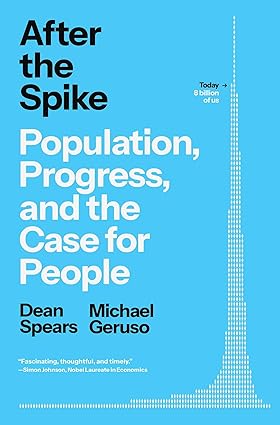
After the Spike: Population, Progress, and the Case for People by Dean Spears and Michael
Geruso (Simon & Schuster, $39.99, 307 pages)
 Concerns about rapidly declining fertility rates are mostly expressed by those on the right-end of the political spectrum. Pro-natalism is unfairly conflated with ideas of Christian nationalist and right-wing populism in political discourse even though the prospect of the number of deaths outpacing the number of births and the resultant decline in population in the absence ofmass immigration has widespread economic and social consequences. Typically, worries about depopulation and its related consequence of a rapidly aging population are framed in terms of the long-term consequences for the affordability of social programs such as old-age pensions and health care. As the population ages, fewer workers will be available to bear the burden of taxes needed to pay for these programs.
Despite the prospects of depopulation and the well-known problems it would present, much of the public is still influenced by the Malthusian fear-mongering of Paul Erhlich and his predicted “Population Bomb.” In 1968, Ehrlich said that the population explosion occurring in the mid- 20th century would soon strip the Earth’s capacity to feed humanity. A strange thing happened instead: as there were more mouths to feed, food production increased, too. Erhlich’s contemporary cousin is the nonsensical commentary about the need for a smaller global population to avert climate disaster.
Into this contentious debate go a pair of University of Texas at Austin economists, Dean Spears and Michael Geruso, to make the case for more people. In their book After the Spike, they marshal the evidence for and against a larger population, debunking myths while arguing that humanity is better off by having more people around. Population grew slowly for centuries while birth rates were high because of high child mortality rates. While there are about 8 billion souls on Earth today, there have been 150 billion people who have lived. But if the global Total Fertility Rate – the number of children that each woman of child-bearing age has in her lifetime – settles in where, for most developed countries around 1.5 today, there would be only about 30 billion people born in the future and global population would crater over the next two centuries. That is, mankind is disappearing: we are going to reach peak population later this century – the spike in the book’s title – before declining rapidly. This pessimistic scenario might be too rosy as a global fertility rate of 1.5 in the future would require several countries such as Communist China, South Korea, Italy, Spain, and Canada to increase its fertility rates from around 1 to 1.3.
Spears and Geruso argue for long-term stabilization, which requires a fertility rate of two. (They settle on two rather than 2.1 because the latter is not exactly true in all places at all times, so two is true enough because of the “inescapable math” that for a stable global population to ever occur, “for every two adults, there must be about two children, generation after generation.”) Most countries have below replacement fertility rates. The problem for those who would like to see the population stabilize, is that the trendline for centuries – ever since approximate data has been available – is that birth rates have been declining “generation by generation.” As the authors note, “populations didn’t grow because birth rates increased,” but rather global population soared over the last 200 years despite declining fertility rates because death rates declined more rapidly, especially childhood deaths. For the most part, these fertility rates fell gradually; it took about 100 years for U.S. fertility rate to fall from six in the early1800s to five in the early 1900s. Global population has tripled since 1950 from 2.5 billion to 8 billion, yet the global birth rate is about half (2.3) what it was 75 years ago (five).
The authors caution against the belief that fertility rates will rebound to something near replacement. Spears and Geruso say there is no “natural” fertility rate for women and there is no basis to think that they will rebound to replacement levels; once they dip below replacement in a country over some period of time, they have never shot back up to that vital benchmark. Some government policies have temporarily increased births but they seem to move women to have children earlier without altering the total number of children they have. Finland’s social policy of childcare and parental leave is often touted as a successful government program to increase fertility rates – which is did briefly from 2000 (1.73) to 2010 (1.86). But its fertility rate has since declined to 1.4 by 2020. The authors make no mention of Hungary’s pro-family policies of tax benefits and targeted handouts for women who have children, but that country’s fertility rates were only briefly arrested before continuing to fall. (Hungary which has tried numerous pro-natal policies gets one mention in After the Spike.)
Why have fertility rates dropped so precipitously over the past few decades? The authors examine several popular arguments including feminism, the availability of contraception and abortion, and the affordability of having children in the 21st century, and rebut each of them with varying degrees of effectiveness. Regarding abortion being a cause of declining fertility rates, the authors note that among low fertility countries, South Korea is the only one that significantly restricts abortion and it persistently has the lowest fertility rate. That is an interesting data point but it hardly proves that abortion is irrelevant to cratering fertility rates in other countries.
More plausibly, the authors argue that contemporary women are less likely to want to have children because they have other options that they prefer. Those options are not limited to education and career, but also inexpensive travel, cheap and readily available entertainment, and spending time with friends. As economists, they note the opportunity costs of having children: the gains forsaken by the choice to have children. Spears and Geruso argue that the cost of children has not gone up financially but the opportunity cost of children has increased dramatically in terms of time; women are unwilling to give up the free time – another phrase for freedom – to do activities that parenting would detract from. This is an important insight.
For many women, having children is simply not an attractive option compared to everything else available to them.Spears and Geruso say that to return to population stabilization of two children per woman, child-bearing and child-rearing has to become more attractive to potential mothers. Doing so would require “changing parenting, changing our economy, and changing our priorities (in culture, in science, and everywhere else.)” What does that mean? It means that fathers would have to take more responsibility when their children are young from getting up at night when a newborn awakens to doing school drop-offs and pickups. But it goes beyond that. The authors are very much of a “it-takes-a-village” mindset, with “non-mothers and non-parents and not-yet-parents and not-yet-grandparents” contributing to changes in society. Some of it makes sense: there should be more medical studies to “make pregnancy better” such as finding a cure for morning sickness.
The authors are not arguing for a growing population but rather one that stabilizes around 8 billion. They argue that contrary to climate change alarmists who fret that more people will worsen global warming, more people will be part of the solution. Echoing the economist Julian Simon, they say that people are a resource and that having more people in the future increases the likelihood of solving many of society’s and the world’s problems. Fewer people make it less likely that we will cure cancer or arrest anthropomorphic climate change. “A more populous future would raise living standards,” Spears and Gruso say, “because people contribute to the ideas, creativity, experimentation, and technology that benefits others.”
The authors insist that any government hoping to increase fertility rates must support legal abortion and the easy availability of contraception. (One of the authors worked in the Biden administration on projects to increase the availability of abortion.) The authors seem incapable of questioning any aspect of political liberalism, and it is no minor weakness in their argument. There is plenty in this book that conservatives will find objectionable – what do the authors mean when they “we have a duty … to share” the abundance that is created? — but if their arguments help convince liberals who need to hear a pro-natal one to have more children or invest in helping families that may want two or more children achieve their fertility goals, that’s great. What is most welcome, however, is the authors’ insistence that “more good is better” as they lament the outcome of a depopulating world: “many billions of lives that could be excellent and full of wellbeing and joy would never be lived.” The authors have faith that the trendline of continually improving living standards will go on forever so there is no need to fret that future lives will be ones of squalor. They argue, “we shouldn’t care only about the quality of lives, but also how many people get to enjoy them” and they insist this is true even without a religious underpinning. Pro-natal means being pro-people, and the authors are unabashedly so.
Population will not stabilize on its own. Moving fertility rates in the right direction will be the result of choices that individuals, society, and governments make. The need to do so has been made in After the Spike and the authors have no illusion that things will turn around quickly. They hope to spark interest in the issue and therefore more thought about what a society that makes it easier for families to have more children might entail, and ultimately become a reality.
Leave a Reply
You must be logged in to post a comment.