
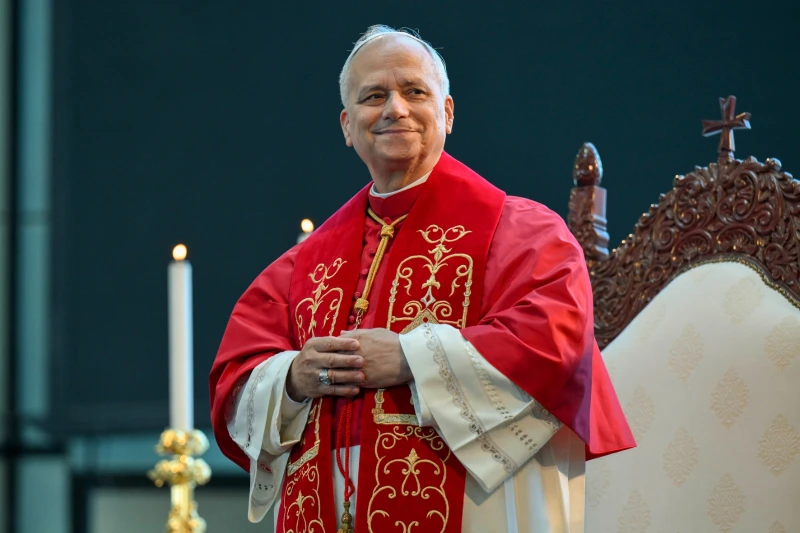
Pope Leo XIV in Harissa, Lebanon, on Dec. 1, 2025. / Credit: Vatican Media
Beirut, Lebanon, Dec 1, 2025 / 10:35 am (CNA).
Pope Leo XIV told Lebanon’s religious leaders on Monday that their country remains a sign to the world that fear and prejudice do not have the final word. At an ecumenical and interreligious meeting in Beirut’s Martyrs’ Square, the pope said Lebanon shows that unity, reconciliation, and peace can take root even amid profound differences.
In his address, the Holy Father recalled Pope Benedict XVI, who wrote in 2012 that the Church’s mission is to dialogue with followers of other religions, guided not by political interests but by theological truths rooted in faith. Pope Leo said Lebanon proves this kind of dialogue is possible, where minarets and bell towers stand side by side and bear witness to belief in the one God.
The pope said the world often watches the Middle East with trepidation, yet hope emerges when the focus turns to what unites people — their shared humanity and belief in a God of mercy. Lebanon, he said, “remains a sign that unity and peace can be achieved.” He also cited the Second Vatican Council’s declaration Nostra Aetate, on the Church’s relation to non-Christian religions, which opened a new horizon for encounter, rejected prejudice, and affirmed the dignity of every person. Leo concluded by calling the Lebanese “builders of peace,” both within their borders and throughout the world.
Before the address, Pope Leo was welcomed at the entrance of the meeting tent by the Syriac Catholic patriarch, the Maronite patriarch, the Grand Sunni imam, and a Shia representative. The program included chanting from the Gospel, a moment of silence, and chanting from the Quran. Leaders from Sunni, Greek Orthodox, Shia, Syriac Orthodox, Druze, Armenian Orthodox, Protestant, and Alawite communities offered brief remarks, interspersed with chants. After Leo spoke, participants planted an olive tree and ended with a final prayer for peace.
Martyrs’ Square in central Beirut is widely regarded as the symbolic heart of the capital. It takes its name from Lebanese and Arab nationalists executed there by Ottoman authorities in 1916 and has long served as the city’s civic center. The square has been the site of major demonstrations that crossed sectarian lines, including the 2005 Cedar Revolution following the assassination of former Prime Minister Rafik Hariri, the nationwide 2019 protests against corruption and economic collapse, and the public outcry after the 2020 Beirut port explosion. These movements expressed frustration with Lebanon’s entrenched sectarian political system and highlighted the square’s enduring role as a gathering place where citizens of all faiths call for reform. Pope Leo’s meeting with religious leaders reinforced that symbolic role.
The Holy Father’s message was directed to leaders of a society shaped by a complex sectarian power-sharing structure, where political figures influenced by regional powers often block national decision-making. Lebanon does not publish official religious statistics, but most estimates hold that roughly 70% of the population is Muslim and about 30% Christian, the highest Christian proportion of any Arab country. Maronite Catholics form the largest Christian community.
Leave a Reply
You must be logged in to post a comment.